
Flying Cars Are Now a Reality: Here’s How They Work and What It Means for the Future of Mobility
For decades, the “flying car” was the ultimate symbol of a distant, unreachable future—a staple of science fiction movies and ambitious sketches. However, as we cross into the second half of 2026, that vision is no longer confined to the silver screen.
From the crowded streets of Mumbai to the high-tech corridors of Guangzhou, the transition from asphalt to airspace has officially begun.
With urban congestion reaching a breaking point globally, the mobility sector is undergoing its most radical shift since the invention of the internal combustion engine.
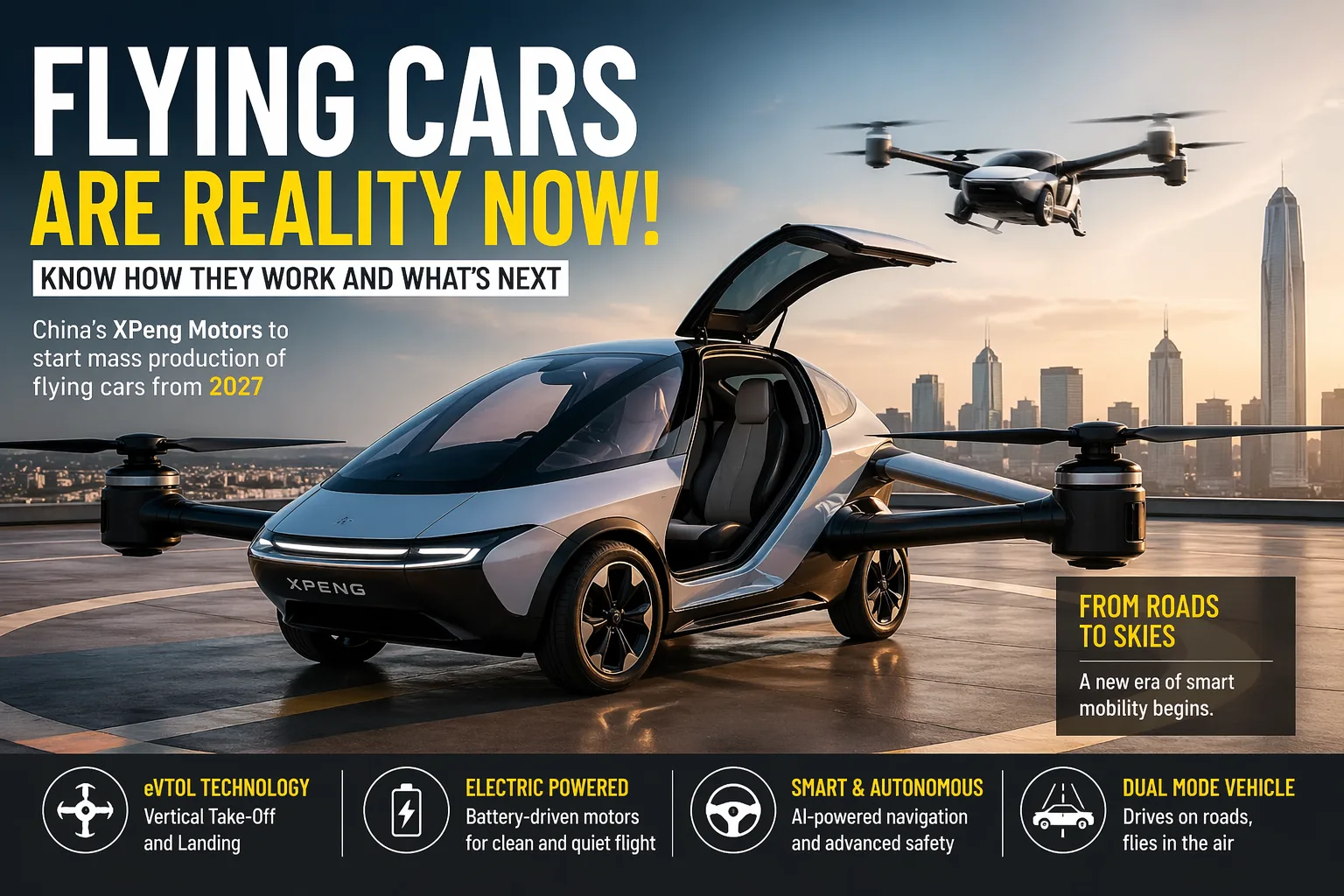
Leading this charge is Xpeng AeroHT, the aviation arm of Chinese EV giant Xpeng, which has turned skepticism into a multi-billion dollar pre-order book. The flying cars reality is here, and it is poised to redefine how we perceive distance and travel.
Flying Cars Are No Longer Sci-Fi
The journey from concept to commerce has been remarkably swift. Just a few years ago, “flying cars” were merely experimental drones with seats. Today, they are sophisticated vehicles entering the mass production phase. Xpeng has recently confirmed plans for large-scale production of its modular flying car starting in 2027, backed by a staggering 7,000+ pre-orders from around the globe.
This isn’t just about a few wealthy hobbyists. The scale of investment and the preparation of dedicated factories—capable of churning out thousands of units annually—signals that the future of transportation is ready for its aerial debut. We are moving from the era of “demonstration flights” to the era of “delivery timelines.
eVTOL Technology Explained: How Flying Cars Actually Work
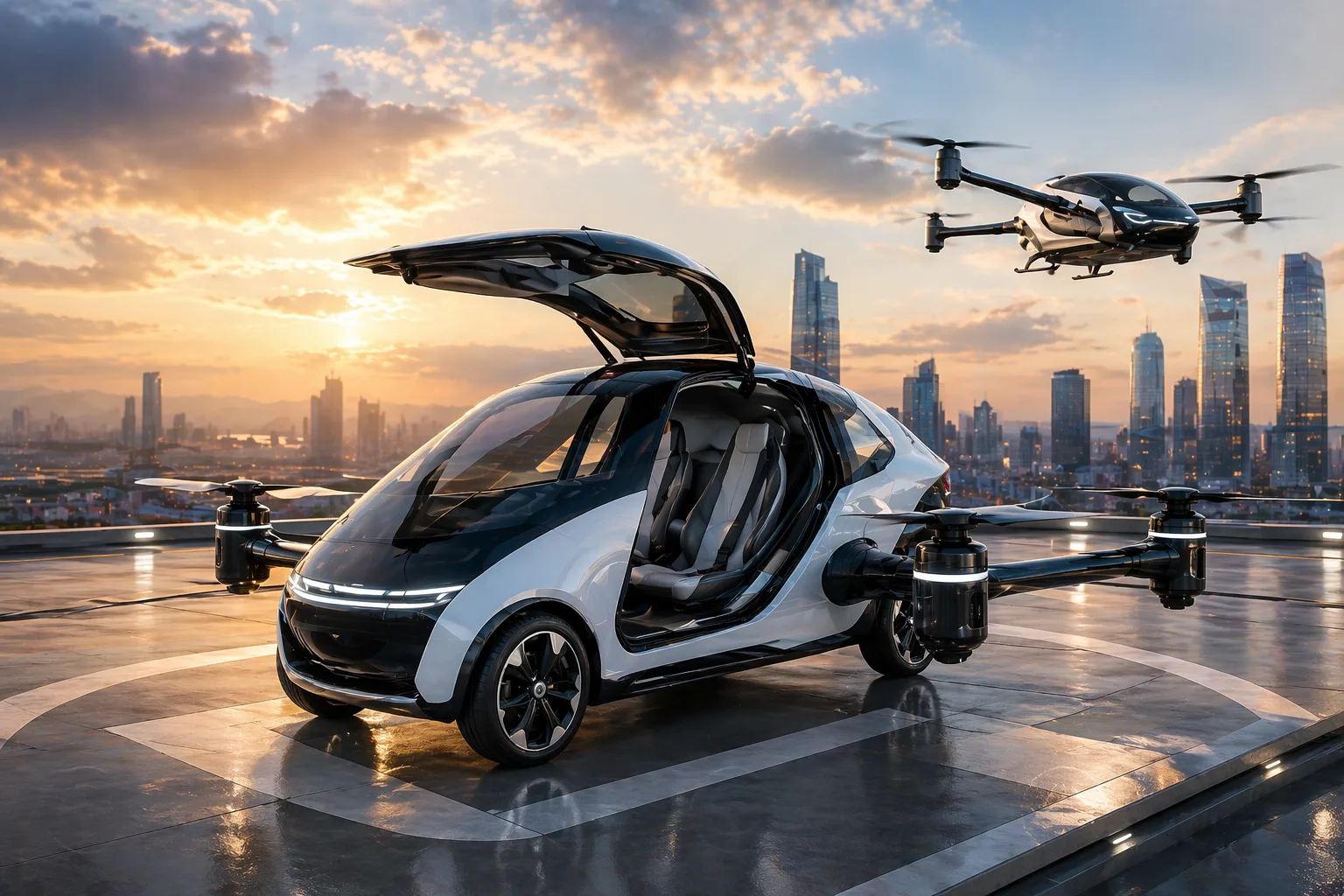
To understand how these vehicles operate, we must look at eVTOL technology explained. eVTOL stands for Electric Vertical Take-Off and Landing. Unlike traditional airplanes that require long runways, or helicopters that are noisy and mechanically complex, eVTOLs use distributed electric propulsion.
The Mechanics of Flight
Vertical Lift: Instead of one large rotor, flying cars use multiple small electric motors and rotors. This provides redundancy; if one motor fails, the others compensate to ensure a safe landing.
Battery-Powered Efficiency: These vehicles are 100% electric. Advances in energy density have finally made it possible to lift a 2-ton vehicle vertically and still provide enough range for cross-city hops.
Transitioning Modes: Most flying cars feature a dual-mode system. In “Ground Mode,” they function like a standard EV. In “Flight Mode,” arms extend to reveal rotors, allowing the vehicle to lift off directly from a driveway or a designated “vertiport.”
Autonomous Intelligence
Safety is managed by advanced AI and autonomous flight control systems. These systems handle the complex physics of stabilization and navigation, meaning the “pilot” of the future may need more of a supervisor’s license than a traditional commercial pilot’s certification.
Xpeng Flying Car: What Makes It Unique?
The Xpeng flying car (specifically the “Land Aircraft Carrier”) stands out because of its ingenious modular design. Rather than trying to make one vehicle do two things poorly, Xpeng created a two-part system:
The Ground Module: A 6×6 all-wheel-drive electric van that looks like a lunar rover. It houses a cabin for 4–5 passengers and acts as a mobile charging station.
The Air Module: A detachable, fully electric 2-seater aircraft that sits inside the rear of the van.
When you hit a traffic jam, you don’t fly the whole car. You deploy the aircraft module, take off vertically, and leave the gridlock behind. This “carrier” concept solves the major hurdle of “where to park a plane”—you simply drive it back into your garage.
Why Flying Cars Are Becoming Possible Now
Three critical technological convergences have made this “impossible” dream a reality:
Energy Density: Batteries can now hold enough power to meet the high-energy demands of vertical take-off while maintaining a lightweight profile.
Computing Power: AI can now process millions of data points per second to manage air traffic, collision avoidance, and flight stability in real-time.
Material Science: The use of carbon fiber and high-strength composites allows these vehicles to be incredibly light yet strong enough to pass both automotive crash tests and aviation safety standards.
Challenges & Limitations
Despite the excitement, the path to the skies is not without turbulence.
Regulatory Hurdles: Aviation laws were written for 747s, not thousands of flying cars. Creating a “Density-Based Airspace Management” system is a massive undertaking for governments.
Infrastructure: We need “Vertiports”—dedicated landing and charging pads—integrated into our skyscrapers and parking lots.
- Public Acceptance: Noise pollution and the “fear factor” of vehicles flying over residential areas remain significant barriers to mass adoption.
What It Means for India
In the Indian context, the potential is enormous but the challenges are unique. Cities like Mumbai and Bengaluru are among the most congested in the world. India has already begun preparing for this shift with the Bharatiya Vayuyan Adhiniyam, 2024, which sets the legislative stage for Urban Air Mobility (UAM).
While personal flying cars like Xpeng’s may remain a luxury for the ultra-wealthy in the short term, the first real-world application in India will likely be Air Taxis. Trials are already being discussed for 2026–2027 to connect airports to city centers (e.g., Kempegowda Airport to Electronic City), turning a 2-hour crawl into a 12-minute flight.
The Future of Transportation
As we look toward 2030, the integration of the aerial and terrestrial EV ecosystems will be seamless. We will see the rise of “Smart Cities” where aerial transport networks are as common as subway lines. Flying cars won’t just be for the rich; they will eventually serve as emergency medical vehicles, organ transport units, and rapid-response disaster relief tools.
The transition won’t happen overnight, but the infrastructure is being laid today. We are currently in the “Early Adopter” phase, similar to where electric cars were in 2012.
Conclusion
The era of 3D transportation is officially here. From Xpeng’s mass-production targets to the evolving aviation laws in India, the momentum is unstoppable. We are witnessing the birth of a new industry that promises to give us back the one thing we lose every day in traffic: time.
The question is no longer if flying cars will arrive, but how soon they will become part of everyday life. In 2026, we are finally looking up instead of just staring at the bumper in front of us.