Tesla Recalls 173 Cybertrucks Over Potentially Dangerous Wheel Issue
Tesla has officially issued another recall for its polarising, futuristic Tesla Cybertruck pickup, adding to a growing list of technical hurdles for the stainless-steel EV.
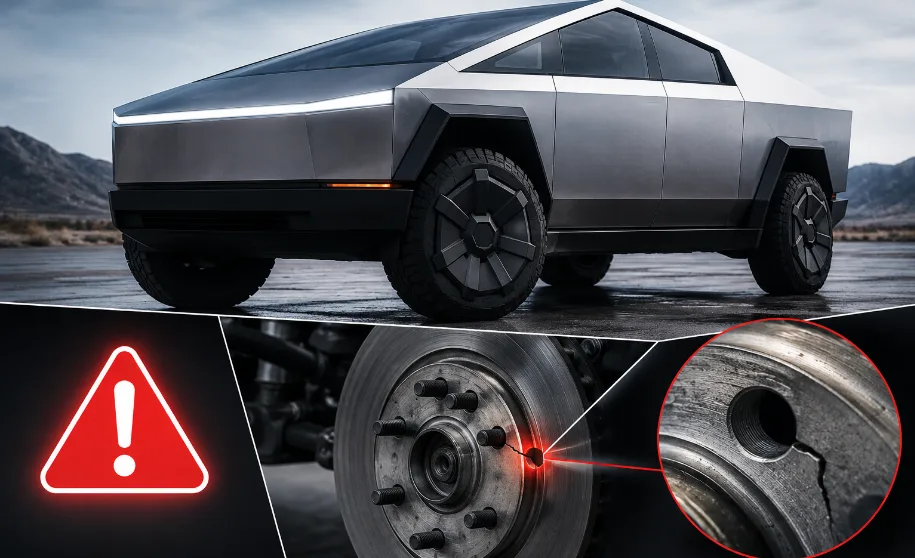
This latest safety campaign affects a specific batch of 173 units due to a potentially hazardous wheel-related defect that could lead to catastrophic failure if left unaddressed. According to the manufacturer, the recall impacts certain 2024–2026 Tesla Cybertruck models equipped with 18-inch steel wheels.
Automotive safety regulators have warned that the defect significantly increases the risk of a crash, particularly under demanding driving conditions, marking another high-stakes challenge for Tesla’s flagship electric truck.
Problem with Tesla Cybertruck
The technical core of the recall revolves around the structural integrity of the wheel assembly. According to documentation filed with the National Highway Traffic Safety Administration (NHTSA), cracks may develop in the brake rotor stud holes.
These stress fractures are likely to occur when the vehicle is subjected to the high-load demands typical of rough off-road terrain or aggressive high-speed cornering. If these cracks propagate, the wheel stud could eventually separate from the wheel hub entirely.
Such a failure would compromise vehicle stability and steering controllability, creating a high-risk scenario for the driver and other road users. Fortunately, Tesla has confirmed that there have been no reported accidents, injuries, or fatalities linked to this specific defect to date.
To rectify the issue, Tesla has committed to a comprehensive hardware replacement program. Service centers will replace the front and rear brake rotors, hubs, and lug nuts on all affected vehicles at no cost to the owners. Internal reports suggest the root cause of the failure may be traced back to a manufacturing or component management error during a specific production window.
Also Read: 2026 Skoda Kodiaq Debuts With ADAS Features – Variants, Highlights & New Features Explained
Notification for the Tesla Cybertruck
Tesla has already begun the process of notifying affected customers via mail and digital alerts. Owners can also check their Vehicle Identification Number (VIN) on the Tesla or NHTSA recall portals to confirm if their truck is part of this specific 173-unit batch.
This latest development marks another entry in what has become a lengthy and scrutinized list of Tesla Cybertruck recalls and controversies. Since its launch, the pickup has faced various service campaigns involving its accelerator pedals, loose exterior trim panels, failing windshield wiper motors, and various software glitches affecting lighting systems and rear-view camera displays.
While every new vehicle platform experiences “teething issues,” the frequency and diversity of the Cybertruck’s mechanical and software failures are raising serious questions among industry analysts regarding Tesla’s quality control and manufacturing consistency for such a radical and complex vehicle architecture.
Despite the limited number of vehicles involved in this particular “wheel issue” recall, it has reignited intense online debate concerning the Cybertruck’s real-world reliability. Interestingly, industry enthusiasts have noted that the small recall size—specifically targeting the 18-inch steel wheel variant—might offer an unintended glimpse into Tesla’s sales mix.

Some market reports suggest that the limited scope of this recall indirectly highlights lower-than-anticipated demand for the base Rear-Wheel Drive (RWD) Cybertruck variant, which typically features these specific steel wheels, compared to the more popular Dual-Motor and Cyberbeast trims.
In conclusion, while Tesla continues to redefine the boundaries of EV technology and avant-garde automotive design, these recurring safety recalls present a persistent hurdle.
For a vehicle marketed on its toughness and “exoskeleton” durability, repeated trips to the service bay for fundamental mechanical issues may eventually erode customer confidence.
As Tesla moves further into the 2026 production cycle, the focus must shift from simply pushing the envelope of design to ensuring the long-term reliability and build quality that premium truck buyers expect.
Also Read: 2026 Skoda Kodiaq Vs Hyundai Creta – Which SUV Offers Better Value, Features & Performance?