Maruti Suzuki To Hike Car Prices From June, But Why?
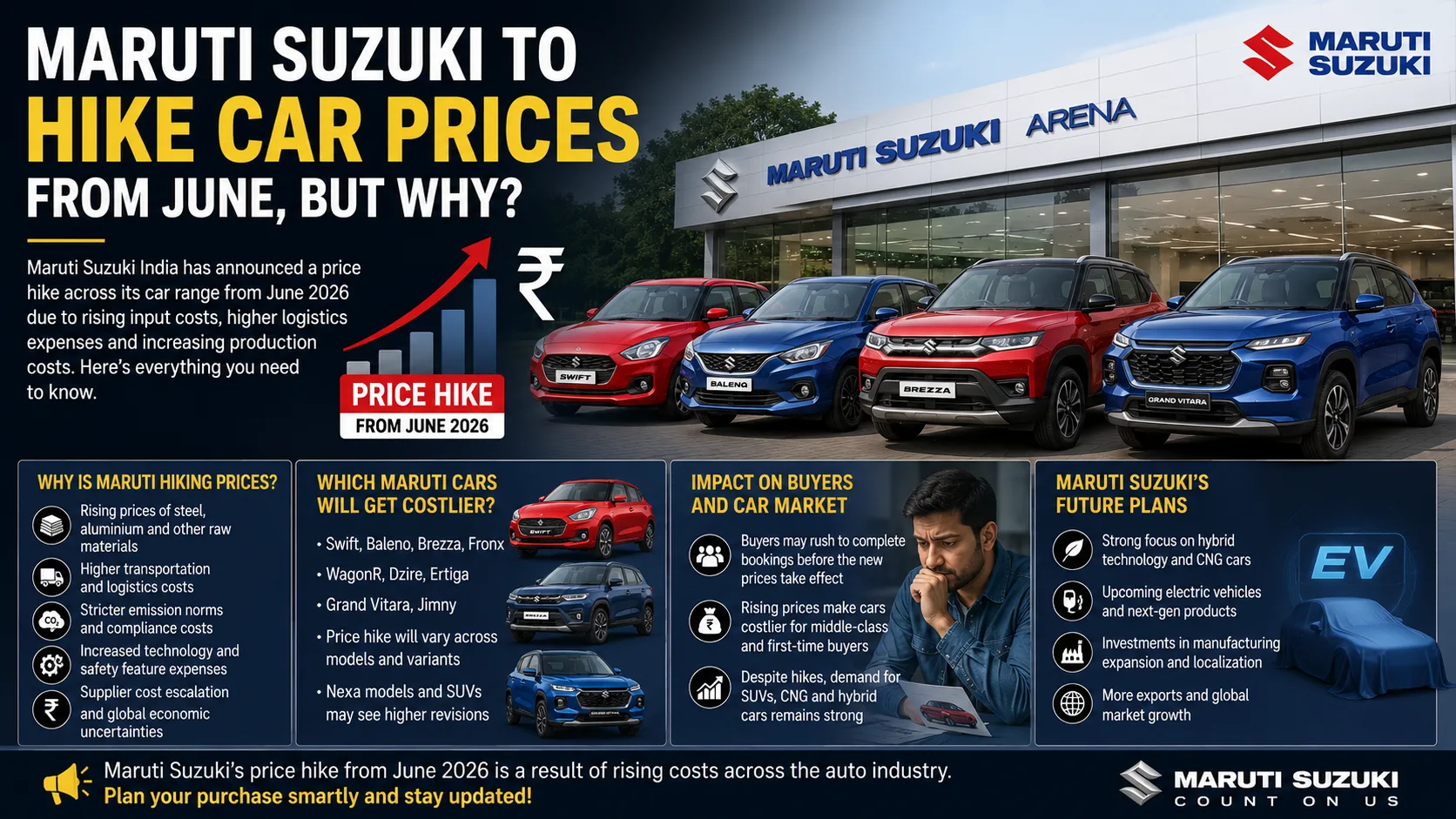
Maruti Suzuki India has announced another price increase across its vehicle lineup, effective from June 2026. The company stated that rising input costs, higher commodity prices, logistics expenses, and an adverse production environment are the key reasons behind this decision.
As India’s largest car manufacturer, even small price revisions by Maruti Suzuki can significantly affect the Indian passenger vehicle market.
This announcement follows a broader industry trend, as several carmakers—including Tata Motors, Hyundai, Mahindra, and Kia—have recently increased vehicle prices due to rising operational costs and inflationary pressures.

Why Maruti Suzuki Is Increasing Prices?
The upcoming price hike is primarily driven by a sustained rise in the cost of essential raw materials like steel, aluminium, and plastics.
Additionally, increasing transportation and logistics costs, geopolitical supply chain disruptions in West Asia, and fluctuating foreign exchange rates have significantly elevated manufacturing expenses. Stricter emission norms and supplier cost escalations for integrating advanced safety and connected car features have added to the pressure.
While Maruti Suzuki undertook cost-reduction measures over the past few months to absorb these costs internally, the persisting adverse cost environment has made a partial price pass-through unavoidable.
Which Maruti Cars Could Become Expensive?
The price hike will affect vehicles sold through both Arena and Nexa retail networks, with regulatory filings indicating an increase capped at ₹30,000 depending on the model and variant.
Popular mass-market models like the Swift, Dzire, WagonR, Ertiga, Brezza, and Victoris are expected to see revised pricing. Premium Nexa models and utility vehicles—including the Baleno, Fronx, Grand Vitara, Jimny, Invicto, and the newly launched e Vitara electric SUV—will also face adjustments.
Premium variants packed with advanced tech and additional safety features could see higher structural revisions compared to entry-level hatchbacks.
Impact On Buyers And Car Market
For Indian car buyers, this announcement creates a window of urgency. Customers planning to buy a new Maruti vehicle may rush to complete their bookings before May ends to beat the June 1 roll-out.
Repeated price hikes across the passenger vehicle industry, combined with recent retail fuel price surges, are making car ownership increasingly expensive for first-time buyers and middle-class families.
Despite these rising costs, the broader Indian car market continues to showcase robust resilience, with strong consumer demand for utility vehicles, CNG cars, and fuel-efficient hybrids holding steady.
Maruti Suzuki’s Future Plans
To navigate these economic challenges and maintain a firm hold on its 42% domestic market share, Maruti Suzuki is focusing heavily on manufacturing expansion and deeper localization.
The company is investing significantly in cleaner technologies, strengthening its dominant CNG portfolio, and expanding its strong hybrid lineup to offer lower running costs.
Furthermore, as it gears up for a major push into the electric vehicle space with models like the e Vitara, Maruti Suzuki’s aggressive technology and localized sourcing strategies will play a decisive role in shaping its future vehicle pricing.
Conclusion
Maruti Suzuki’s upcoming June 2026 price hike reflects the persistent inflationary and supply chain pressures affecting the entire Indian automobile sector.
While buying a new car will become slightly more expensive, customer demand for the brand’s reliable, fuel-efficient, and tech-loaded vehicles is expected to remain incredibly strong across multiple segments.
Also Read: 2026 Honda City Facelift Vs Hyundai Verna: Which Car Offers Better Value For Money?