
BYD Racco Debuts in Japan: Can China’s Affordable Electric Kei Car Challenge Nissan Sakura?
The global automotive landscape is witnessing a truly historic shift on Japanese soil. Chinese electromobility powerhouse BYD has officially breached one of the most fiercely guarded automotive sanctuaries in the world by entering the country’s hyper-local microcar space. With the official commercial launch of the all-new BYD Racco, the company has introduced a vehicle explicitly engineered to comply with Japan’s strict domestic light-vehicle tax and dimension regulations.
This strategic move marks the very first time a foreign automaker has manufactured a purpose-built, dedicated electric vehicle to compete directly in this unique segment. By challenging domestic legacy giants on their own turf, the launch of the BYD Racco represents a massive milestone in the Chinese manufacturer’s aggressive global expansion strategy. Japan’s microcar ecosystem, which has traditionally been an impenetrable fortress for overseas brands, is now facing unprecedented disruption from a highly competitive Chinese EV in Japan.
What is the BYD Racco?
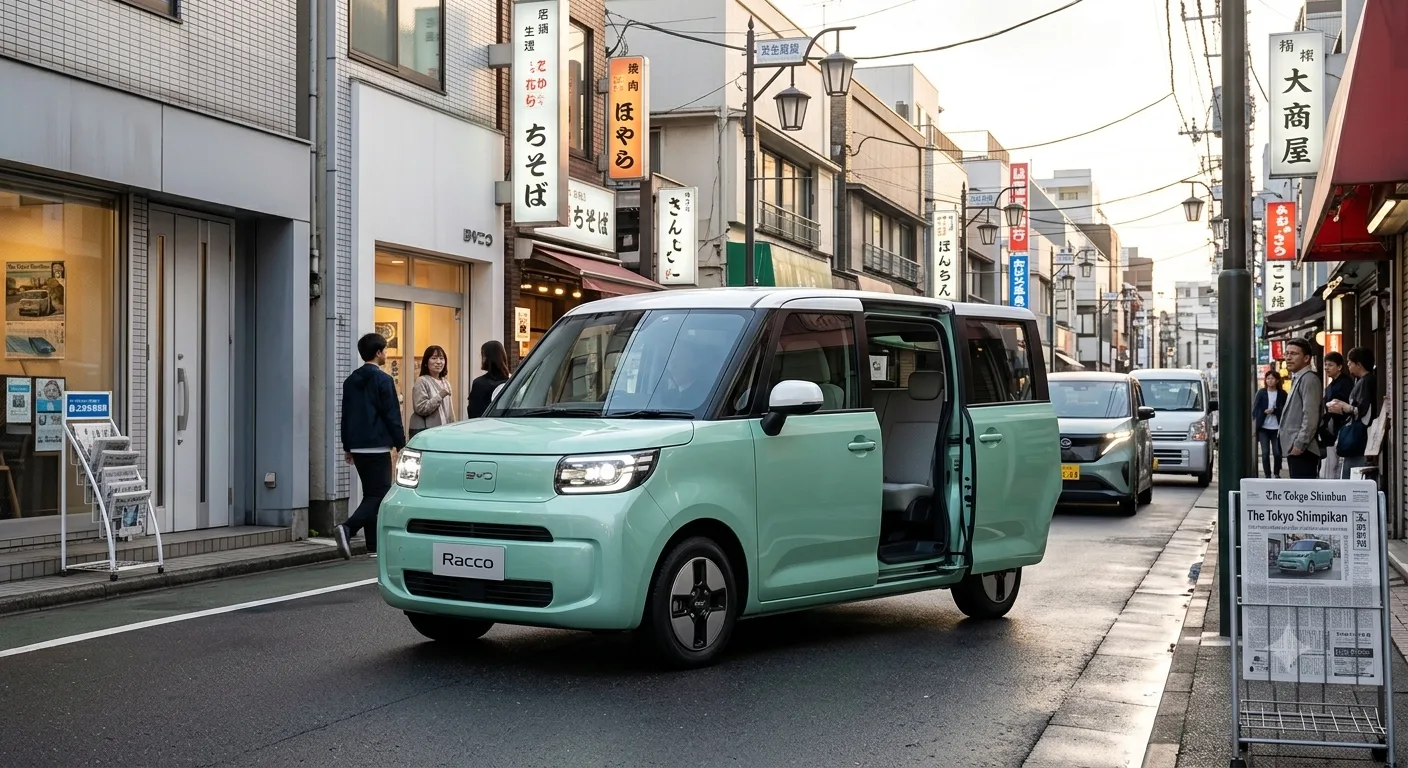
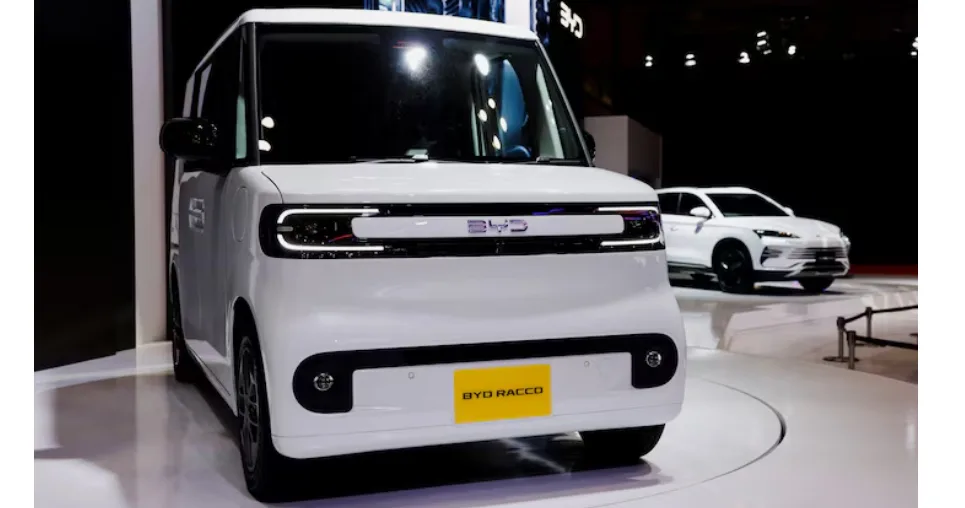
The BYD Racco is a purpose-built electric micro-van engineered specifically to navigate the ultra-narrow streets and tight urban parking spaces characteristic of Japanese cities. Measuring exactly within the regulated dimensions of the microcar category, the vehicle features a classic, boxy exterior maximized for internal volume and family-focused practicality. To elevate its daily usability for urban commuters and young families, the vehicle comes equipped with dual powered sliding rear doors featuring convenient kick-sensor activation.
Despite its compact footprint, the cabin layout comfortably accommodates a standard four-person seating capacity alongside modern technological comforts. The interior features a rotating 10.1-inch central touchscreen, Level 2 advanced driver assistance systems, and bidirectional vehicle-to-load capabilities. BYD is intentionally targeting daily urban commuters, suburban families, and eco-conscious younger drivers who require maximum cabin utility without the bulk of a traditional hatchback or SUV.
BYD Racco Price and Electric Range
Affordability and efficiency are the primary pillars of this new microcar contender. The base manufacturer-suggested retail price for the entry-level BYD Racco starts at an aggressive 2.145 million yen before incentives. Once applicable local government subsidies and EV tax exemptions are factored into the final transaction, the actual out-of-pocket BYD Racco price drops comfortably below the crucial 2 million yen mark. This strategic pricing structural framework makes it an incredibly compelling choice for anyone looking for an affordable electric car Japan can offer.
+-------------------+----------------------+--------------------+-----------------+
| Variant Name      | MSRP (Before Subsidy)| Battery Capacity   | WLTC range      |
+-------------------+----------------------+--------------------+-----------------+
| Racco 200         | 2.145 Million Yen    | 20 kWh LFP Blade   | 210 km          |
| Racco 300 Plus    | 2.390 Million Yen    | 30 kWh LFP Blade   | 320 km          |
| Racco 300 Premium | 2.490 Million Yen    | 30 kWh LFP Blade   | 320 km          |
+-------------------+----------------------+--------------------+-----------------+
Range anxiety is heavily mitigated by the inclusion of the manufacturer’s proprietary lithium iron phosphate Blade battery technology built on the advanced e-Platform 3.0. The baseline version delivers a competitive 210 km of driving range, while the higher-tier trims boast a segment-leading 320 km under standard WLTC testing cycles. Achieving a range that exceeds the 300 km threshold is highly significant, effectively raising the performance bar for the entire electric kei car Japan market.
Why BYD Chose Japan’s Kei Car Segment
Entering this distinct vehicle classification is a calculated masterstroke for the growth of BYD Japan. Microcars represent roughly 40% of all new passenger vehicle sales across the country, making it the single largest automotive volume driver in the nation. The enduring popularity of these micro-vans stems from immense practicality, lower tax rates, reduced ownership costs, and unmatched maneuverability in crowded metropolitan zones.
Historically, this massive slice of the Japanese EV market has been fully locked down by domestic legacy brands like Suzuki, Daihatsu, and Honda. Foreign manufacturers have routinely failed to gain traction in the region because they attempted to sell oversized Western vehicles ill-suited for local infrastructure. By spending the time and resources to develop a dedicated BYD kei car, the Chinese brand is demonstrating that it respects local consumer preferences and intends to capture real market volume rather than remaining a niche luxury importer.
BYD vs Japanese Automakers
The arrival of the new micro-van sets up a direct confrontation with established domestic champions. The primary target in its crosshairs is the immensely popular Nissan Sakura rival, which currently rules the local electric microcar domain alongside its mechanical twin, the Mitsubishi eK X EV. While the Nissan Sakura offers a respectable 180 km of range out of a 20 kWh battery pack, the baseline BYD Racco beats it out of the gate with a 210 km range at a highly competitive initial price point.
Furthermore, the flagship trims of the Chinese competitor stretch that advantage to a massive 320 km, offering nearly double the driving range of its domestic counterpart. In terms of features, the newcomer introduces premium additions like hands-free power sliding doors and a robust infotainment stack that local options lack. However, the true battleground will be customer brand perception, as domestic buyers still hold deep-seated loyalty toward heritage Japanese nameplates.
Why This Launch Matters Globally
The debut of the BYD Racco carries profound implications that reverberate far beyond the borders of Tokyo. As the Chinese domestic market experiences intensifying price wars and saturation, international expansion has become the primary growth engine for major EV producers. Proving that a Chinese vehicle can successfully penetrate, adapt to, and compete within a highly conservative market like Japan sends a powerful message to global regulators and competitors alike.
Successful adoption in this region will undoubtedly bolster the brand’s reputation for engineering flexibility in other highly developed regions like Europe and the Asia-Pacific. If this project succeeds, it will likely serve as a blueprint for launching localized, ultra-efficient electric mini car models worldwide. Legacy international brands will face immense pressure to accelerate their own affordable EV architectures or risk losing immense market share to agile foreign players.
Challenges Ahead
Despite offering a highly disruptive product, the road ahead for BYD EV Japan is filled with structural hurdles. Japanese consumers are famously conservative automotive buyers, showing a historical preference for domestic dealer networks and long-term brand equity. Building up a robust, nationwide network of physical authorized showrooms and service points to foster long-term customer trust requires monumental capital and time.
Additionally, overall battery-electric vehicle adoption in the country remains stubbornly low compared to hybrid options, meaning the brand must actively convert traditional internal combustion engine buyers. The company is actively working to soften these barriers by emphasizing stellar safety performance evaluations and offering robust over-the-air software support. The ultimate sales trajectory of this micro-van will serve as the definitive test of whether foreign electric mobility can truly capture the hearts of mainstream Japanese buyers.
Expert Analysis
This high-stakes launch is far more significant than simply adding another compact hatchback to an existing overseas portfolio. By designing a vehicle from scratch to meet the hyper-specific dimensions and strict regulatory frameworks of a foreign nation, the manufacturer has proven its immense industrial agility. It highlights a dramatic shift where a Chinese automotive brand is no longer just exporting domestic surpluses, but actively dictates localized product development on a global scale.
Should this venture capture even a minor fraction of the massive local microcar segment, it will force domestic legacy brands to completely re-evaluate their timeline for pure electric mobility. Japanese carmakers have spent years prioritizing robust hybrid drivetrains over pure battery electric vehicles. The aggressive packaging and pricing of the Racco might just be the urgent wake-up call that forces the local industry to fast-track affordable, next-generation EV platforms.
Conclusion
The launch of the BYD Racco marks a defining moment in the modern automotive era. By blending segment-leading WLTC driving range, family-focused powered sliding doors, and a highly disruptive post-subsidy price point, the vehicle presents an undeniable value proposition. While overcoming entrenched domestic brand loyalty will be a steep uphill battle, the sheer engineering and fiscal value offered cannot be easily ignored by consumers. This ambitious little micro-van may very well be remembered as the exact catalyst that fundamentally transformed the future of affordable electric mobility across Japan.


