
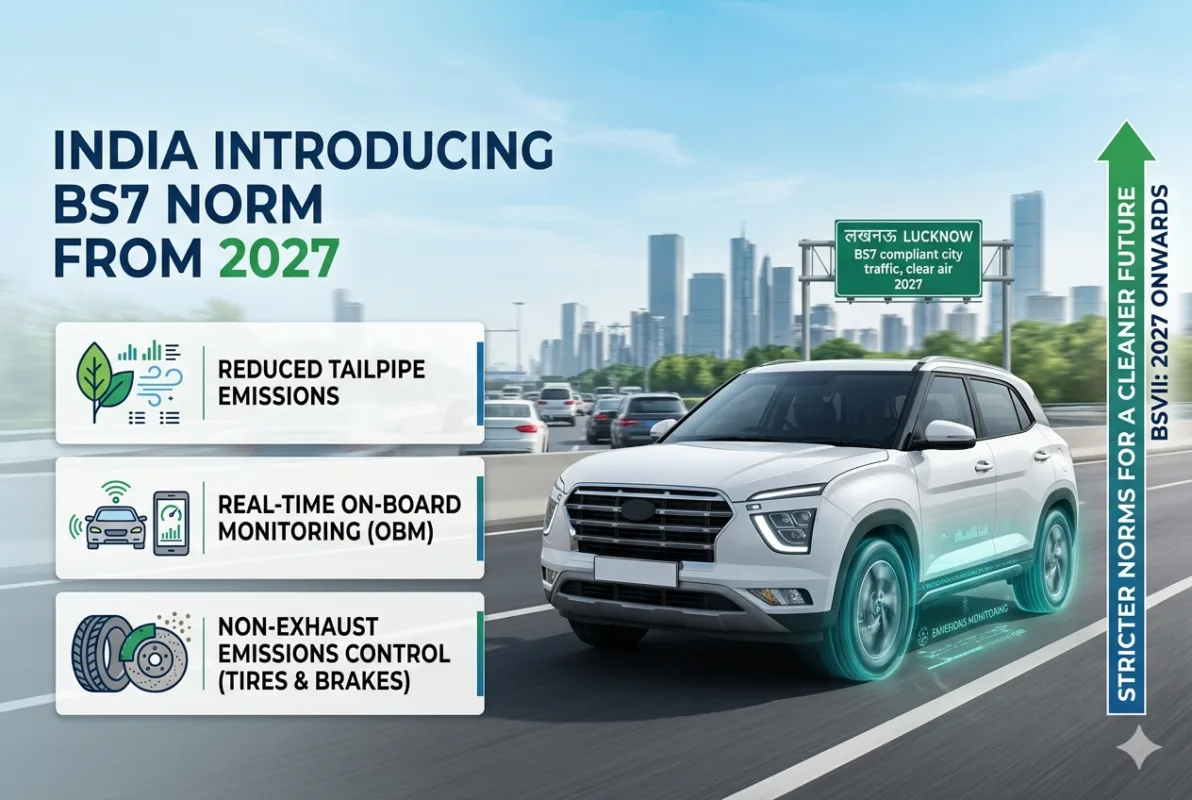
The Indian automotive landscape is bracing for its most significant regulatory shift since the leap to BS6 in 2020. The Government of India, through the Ministry of Environment, Forest and Climate Change, is set to introduce Bharat Stage 7 (BS7) emission norms by early 2027.
This move aims to align India’s vehicular standards with the global Euro 7 regulations, moving beyond mere tailpipe emissions to a holistic environmental approach.
While the current BS6 Stage II (RDE) norms focused on real-world driving data, BS7 is expected to be a “digital and physical” overhaul.
From tracking microplastics from tires to monitoring engine health in real-time, the upcoming mandate will fundamentally change how vehicles are manufactured and sold in India.

1. On-Board Monitoring (OBM): The Silent Supervisor
The biggest technical leap in BS7 is the introduction of On-Board Monitoring (OBM). While the current BS6 Phase II uses On-Board Diagnostics (OBD) to detect component failures, OBM takes it further by tracking real-time emissions data.
Digital Tracking: Sensors will continuously measure Nitrogen Oxide (NOx), Ammonia, and Particulate Matter (PM) while the car is being driven.
Compliance for Life: If a vehicle’s emission control system degrades over time, the OBM will trigger alerts. This ensures that a car sold as “clean” stays that way even after 1,00,000 kilometers.
2. Regulating “Non-Exhaust” Pollution
In a revolutionary move, BS7 will look beyond what comes out of the exhaust pipe. This makes BS7 relevant even for Electric Vehicles (EVs).
Brake Dust: Friction from braking releases fine metal and carbon particles. BS7 will set limits on these emissions, requiring manufacturers to use advanced brake pad materials.
Tire Microplastics: Tires shed microplastics as they wear against the road. New standards will regulate tire abrasion to curb this invisible but significant source of pollution.
3. Strict Battery Standards for EVs
BS7 ensures that the transition to electric mobility is sustainable in the long term. The new norms will introduce a Battery Durability Index.
Minimum Life Mandate: Manufacturers must guarantee that EV batteries maintain a specific health percentage over a defined period or mileage.
Sustainability: This prevents early battery replacements, reducing environmental waste and improving the resale value of used EVs.
4. Uniform Limits for Petrol and Diesel
Under BS6, diesel engines were allowed slightly higher NOx limits compared to petrol. BS7 is expected to bring uniform emission standards across all fuel types. This “fuel-neutral” approach means diesel engines will need significantly more complex and expensive filtration systems to match the cleaner profile of petrol engines.
5. Market Impact: Price Hikes and Discontinuations
Innovation comes with a cost. The transition to BS7 is expected to make vehicles more expensive across the board.
Entry-Level Hatchbacks: Could see a price increase between ₹30,000 and ₹50,000.
Mid-size SUVs & Sedans: Expected hikes of ₹60,000 to ₹1,00,000.
Luxury & Large Diesel SUVs: Costs could rise by over ₹1,50,000.
The “Diesel Exit”: Much like the BS6 transition, many smaller diesel engines may be discontinued as the cost of making them BS7-compliant will be too high for budget-conscious buyers. This will likely accelerate the push toward Strong Hybrids and EVs.
Also Read: Honda March 2026 Sales Report: Two-Wheeler Dominance Continues While Cars Navigate Challenges
Conclusion: A Cleaner Path Ahead
The move to BS7 by 2027 is a bold step toward a zero-emission future. While the initial price increases may worry consumers, the long-term benefits include significantly better air quality and more durable, high-tech vehicles. For the Indian auto industry, BS7 isn’t just a hurdle—it’s the roadmap for staying globally competitive.
Also Read: Tata Intra EV Pickup Launched in India at Rs 11.95 Lakh