Top 10 Best-Selling Electric Cars Of April 2026 In India
India’s electric car market witnessed massive growth in April 2026, with EV sales rising by nearly 75% year-on-year as buyers increasingly shifted toward electric mobility.
This surge highlights a seismic shift in the Indian automotive landscape, driven by strong government support through revamped subsidy schemes, a rapidly improving charging infrastructure, and significantly better driving ranges offered by new-age battery technology.
As rising fuel prices continue to push traditional internal combustion engine (ICE) owners toward more sustainable alternatives, manufacturers like Tata Motors, Mahindra, MG Motor, Hyundai, and BYD have recorded strong momentum, solidifying their presence in the burgeoning Indian EV marke
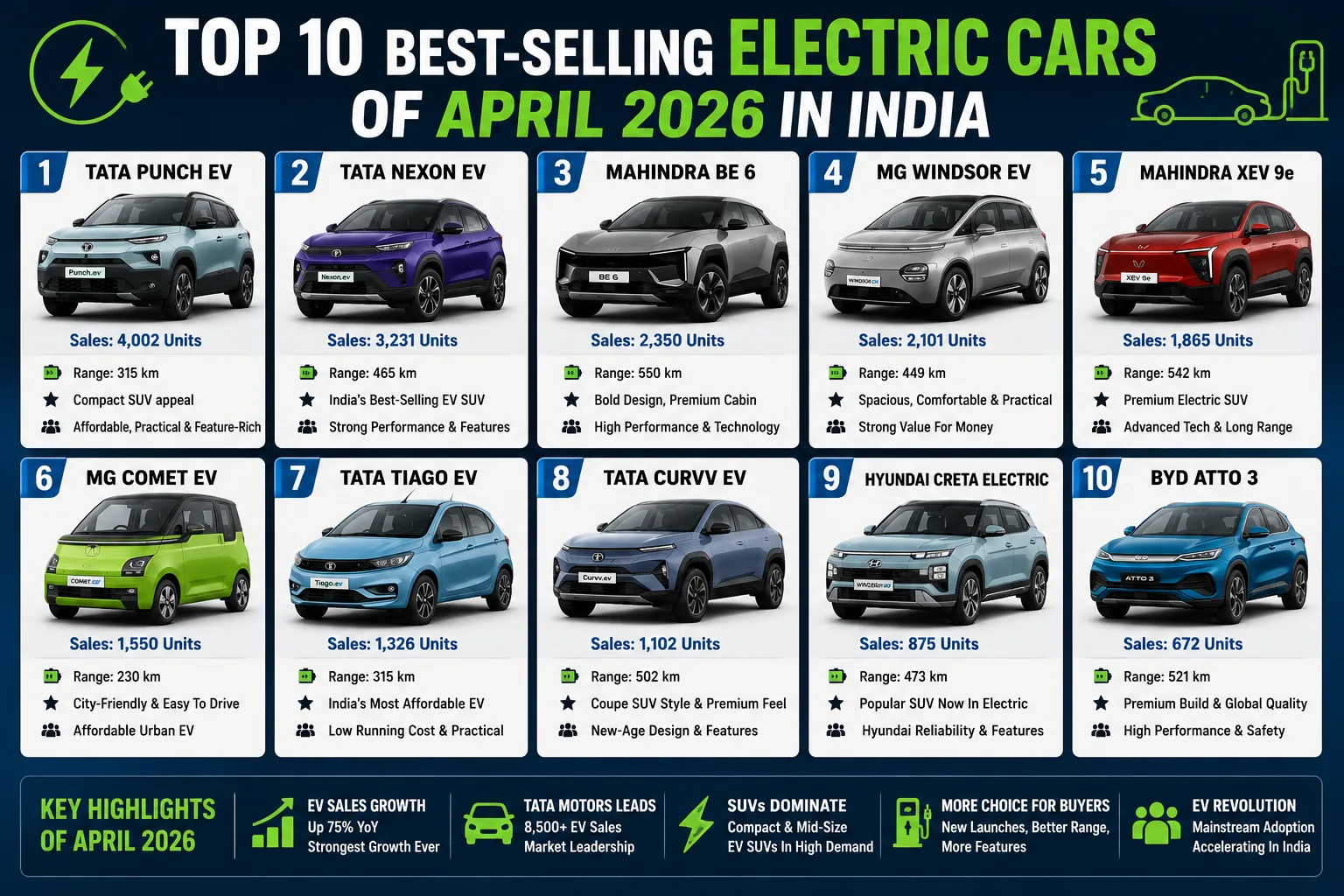
The overall EV market performance in April 2026 was nothing short of historic. The Indian passenger EV segment crossed 23,000 monthly sales, marking one of its strongest performances ever. Tata Motors maintained its undisputed position as the market leader, recording over 8,500 electric vehicle sales during the month.
Hot on their heels were Mahindra and JSW MG Motor India, both of whom have significantly scaled their production to meet the rising demand. This collective performance underscores a maturing market where consumers are no longer just “testing” electric tech but are adopting it as their primary mode of transport.
Top 10 Best-Selling Electric Cars of April 2026 in India
1. Tata Punch EV
The Punch EV has emerged as a powerhouse in the sub-compact segment, dominating the charts with its accessible pricing and rugged SUV appeal.
Offering a range of up to 421 km on a single charge, it remains a favorite for first-time EV buyers who prioritize a high seating position and city-friendly dimensions without compromising on tech like ventilated seats.
Tata Motors recorded strong demand for this model, contributing significantly to its 8,543-unit total for the month.

2. Tata Nexon EV
A long-standing veteran, the Nexon EV continues to hold a top spot due to its proven reliability and comprehensive feature list. With its “Empowered” trims and a range exceeding 465 km, it appeals to families looking for a versatile all-rounder.
Its 5-star safety rating and widespread service network make it the default choice for many. The Nexon EV remains a volume pillar for Tata, helping the brand maintain its 37% market share in April.
3. Mahindra BE 6
One of the fastest climbers on the list, the Mahindra BE 6 is the brand’s flagship for the “Electric Origin” era. Built on the INGLO platform, it offers a futuristic design and a massive 79 kWh battery option.
Buyers are choosing it for its performance-oriented driving dynamics and cutting-edge cockpit experience. This model was a key driver for Mahindra’s total of 5,413 EV units sold last month.
4. MG Windsor EV
The MG Windsor EV has disrupted the CUV (Crossover Utility Vehicle) segment with its unique “Battery as a Service” (BaaS) ownership model.
Its spacious, sofa-like rear seating and premium interiors have made it a hit among chauffeur-driven professionals and tech-savvy urban families who value cabin comfort over outright ruggedness. The Windsor EV served as a major contributor to JSW MG Motor’s 5,006 units in April.
5. Mahindra XEV 9e
Positioned as a luxury electric SUV, the XEV 9e focuses on grand proportions and a premium tech suite, including a triple-screen dashboard. It has gained popularity among buyers looking for a large, feature-loaded electric vehicle that offers a viable, eco-friendly alternative to traditional luxury SUVs in the ₹25-35 lakh bracket. The XEV 9e helped Mahindra secure the second spot on the Leaderboard with over 5,400 total EV sales.
6. MG Comet EV
The Comet EV remains the undisputed king of urban mobility, attracting buyers with its quirky design and ease of maneuverability in congested traffic.
While its range is modest at 230 km, its low running costs and smart tech features like dual 10.25-inch screens make it the perfect secondary car for city dwellers. The Comet EV continues to find consistent takers, supporting MG’s 32% year-on-year growth.
7. Tata Tiago EV
As one of the most affordable electric cars in India, the Tiago EV continues to drive mass adoption. It serves as an entry point into the EV world, offering a practical 315 km range and connected car tech.
Its compact hatchback form factor makes it a highly efficient daily commuter for office-goers. The Tiago EV remains one of the highest-selling electric hatchbacks in the country as of April 2026.

8. Tata Curvv EV
With its striking Coupe-SUV silhouette, the Curvv EV has successfully carved out a niche for itself. It offers a massive 502 km range, appealing to those who want a “statement” vehicle. Its segment-first features, such as a powered tailgate and advanced ADAS, have made it a strong contender in the mid-size SUV space.
9. Hyundai Creta Electric
The electric avatar of India’s favorite SUV has seen a strong reception since its launch. Retaining the “Creta” brand trust, it offers a refined driving experience and a range of around 450 km.
Buyers are flocking to it for its familiar ergonomics, premium cabin feel, and Hyundai’s extensive reliability. Hyundai sold 512 electric units in April, with the Creta EV leading the charge as production continues to scale.
10. BYD Atto 3
Representing the premium end of the mass-market segment, the BYD Atto 3 continues to attract enthusiasts with its world-class Blade Battery technology and unique interior design.
Its high safety standards and impressive real-world range have helped it maintain a steady presence despite increasing competition from domestic giants. BYD India recorded a total of 469 units in April 2026, marking a 17.8% growth over the previous year.
Compact electric SUVs continued to dominate the sales charts in April 2026. This trend is largely attributed to their successful combination of practicality, long-range capabilities, and a commanding road presence that Indian buyers traditionally admire. By keeping these vehicles within an affordable price bracket while offering features found in luxury cars, manufacturers have found the “sweet spot” for the Indian market.
Analyzing the biggest trends from April 2026, it is clear that customers are now prioritizing long-range capabilities and fast-charging infrastructure over simple novelty. There is a visible rising demand for electric SUVs and an increasing acceptance of premium EVs from newer brands like VinFast, alongside the rapid growth of Mahindra’s dedicated EV platforms. Connected technology and Level-2 ADAS features have moved from being “luxury extras” to “essential requirements” for the modern EV buyer.
The competition in the Indian EV market is set to become even more intense with upcoming launches from Maruti Suzuki, Kia, Toyota, and VinFast slated for the latter half of the year. The next phase of EV growth in India is expected to focus heavily on affordable long-range electric SUVs and a significant expansion of the highway charging network, which will further reduce range anxiety for long-distance travelers.
In conclusion, April 2026 clearly showed that India’s electric revolution is gaining serious momentum. EVs are no longer niche products for early adopters but have become mainstream options for Indian buyers across multiple price segments. With a diverse range of models and a competitive ecosystem, the future of mobility in India is unmistakably electric.