Tata Motors To Launch First Flex-Fuel Car By 2026-End
Tata Motors is set to further solidify its position as a leader in sustainable mobility by announcing the launch of its first flex-fuel passenger vehicle by the end of 2026 or early 2027. Shailesh Chandra, Managing Director of Tata Motors Passenger Vehicles and Tata Passenger Electric Mobility, recently confirmed that the company has reached a state of “technology readiness” for higher ethanol blends.
This move comes at a time when the Indian government is aggressively pushing for E85 and E100 fuels to reduce the country’s massive oil import bill and lower carbon emissions. By adding flex-fuel to its arsenal, Tata Motors is signaling that it will not rely solely on electric vehicles but will offer a diverse range of green alternatives to the Indian consumer.
Technology Readiness and Compliance Status
During a recent media interaction, Shailesh Chandra highlighted that Tata Motors is “very comfortable” with the transition to flex-fuel technology.
While the company’s current lineup has been E20 compliant (20% ethanol blend) since 2023, the upcoming flex-fuel models will be designed to handle much higher concentrations, potentially up to E85 (85% ethanol).
Tata Motors is currently working closely with the Society of Indian Automobile Manufacturers (SIAM) and the government to finalize the technical standards for these higher blends.
The government has already proposed amendments to the Central Motor Vehicles Rules to officially recognize E85 and E100, providing the necessary regulatory framework for manufacturers to proceed.
Also Read: BYD Sealion 6 PHEV Spied Again Ahead Of India Launch
The Multi-powertrain Strategy: A Case for the Tata Punch?
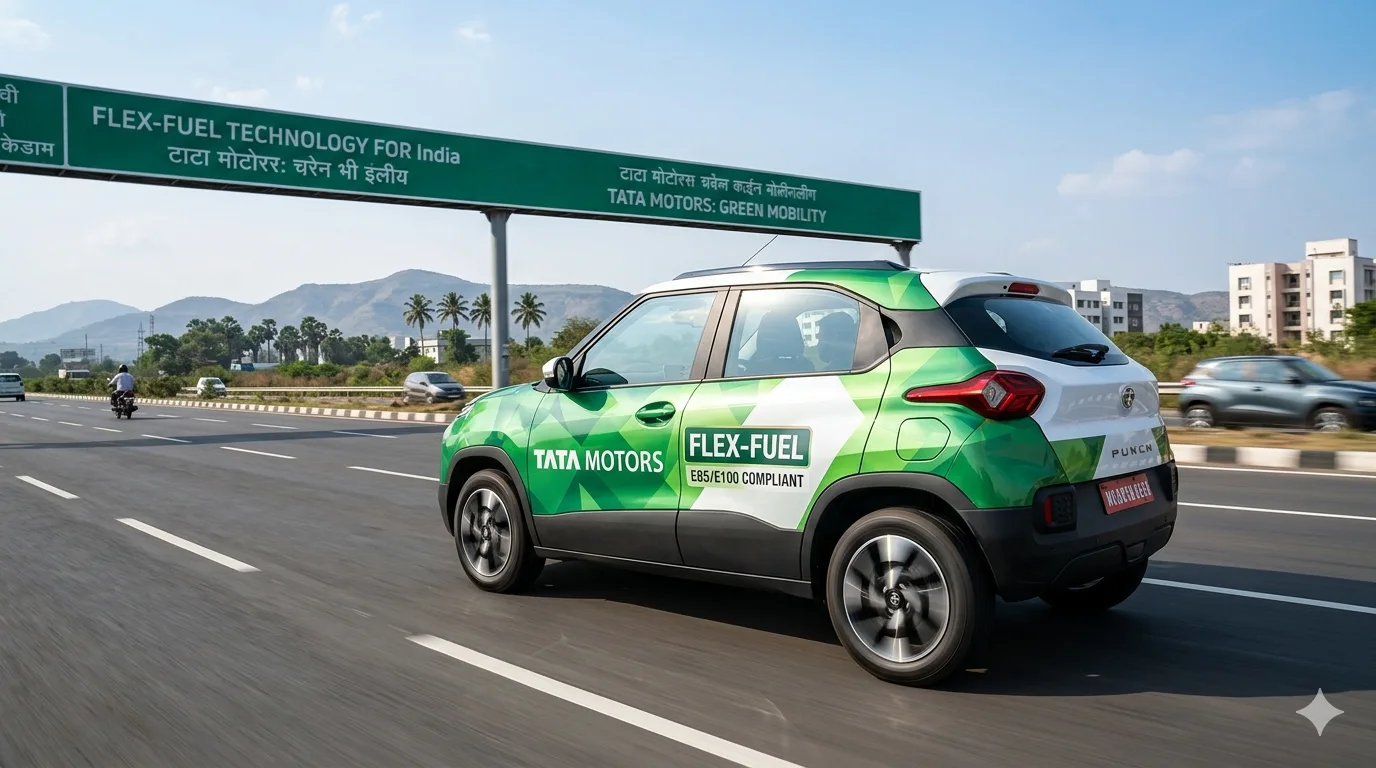
Tata Motors’ success in recent years can be attributed to its “Multi-Powertrain Strategy.” A prime example is the Tata Punch, which is currently available in Petrol, CNG, and Electric (EV) avatars. Introducing a flex-fuel variant would make it one of the most versatile nameplates in the Indian market.
Chandra noted that the company expects to have at least one flex-fuel product ready for a showcase or pilot by early next year, with a commercial market launch slated for late 2026.
This strategy allows Tata to cater to different regional infrastructures—where an EV might work in Bengaluru, a flex-fuel car might be more practical in the sugar-producing belts of Maharashtra or Uttar Pradesh where ethanol availability is higher.
Why Flex-Fuel Matters for India
The push for flex-fuel is a strategic move for both the automaker and the nation. Flex-fuel engines can run on a variety of ethanol-gasoline blends, offering several key advantages:
Reduced Emissions: Ethanol is a cleaner-burning fuel compared to pure gasoline.
Energy Security: Ethanol is produced domestically from sugarcane and food grains, reducing dependence on imported crude oil.
Cost-Efficiency: As domestic production scales up, ethanol-blended fuel is expected to be more affordable for the end-user.
Support for Farmers: The ethanol economy directly benefits the agricultural sector by providing an alternative market for surplus crops.
Competition in the Flex-Fuel Segment
Tata Motors is not alone in this race. Other major players like Maruti Suzuki, Toyota, and Hyundai have already showcased flex-fuel prototypes at various auto expos in India.
Toyota, in particular, has been testing a flex-fuel Camry and Innova Hycross. By setting a definitive timeline of late 2026, Tata Motors is ensuring it remains a frontrunner in the “Beyond EV” conversation.
Conclusion: A Greener Future on All Fronts
The announcement of a 2026 launch for Tata’s first flex-fuel car underscores the brand’s commitment to a multi-pronged approach to decarbonization.
While their EV dominance continues to grow, the integration of flex-fuel technology provides a realistic and immediate solution for long-distance travel and regions with developing charging infrastructure.
As India moves toward its goal of 20% ethanol blending nationwide by 2025-26, Tata Motors is perfectly positioned to lead the charge into the next era of Indian motoring.
Also Read: BYD Sealion 6 PHEV Spied Again Ahead Of India Launch
Frequently Asked Questions (FAQs)
1. What is a flex-fuel car?
A flex-fuel vehicle (FFV) has an internal combustion engine capable of running on more than one type of fuel, typically a blend of petrol and ethanol (ranging from E20 to E100).
2. When will Tata Motors launch its first flex-fuel car?
According to MD Shailesh Chandra, the first flex-fuel product from Tata Motors is expected by late 2026 or early 2027.
3. Will existing Tata cars run on E100 fuel?
No, existing cars are currently E20 compliant. To run on E85 or E100, the engine requires specific modifications to the fuel system, seals, and engine mapping, which will be introduced in the new 2026 models.
4. Which Tata model will get flex-fuel first?
While not officially confirmed, the Tata Punch is a top contender given Tata’s history of offering multiple powertrain options for that specific model.
5. How does flex-fuel benefit the environment?
Ethanol is a renewable fuel that produces fewer greenhouse gas emissions and tailpipe pollutants compared to traditional fossil fuels.