
VinFast Temporarily Halts Local EV Production Plans in India
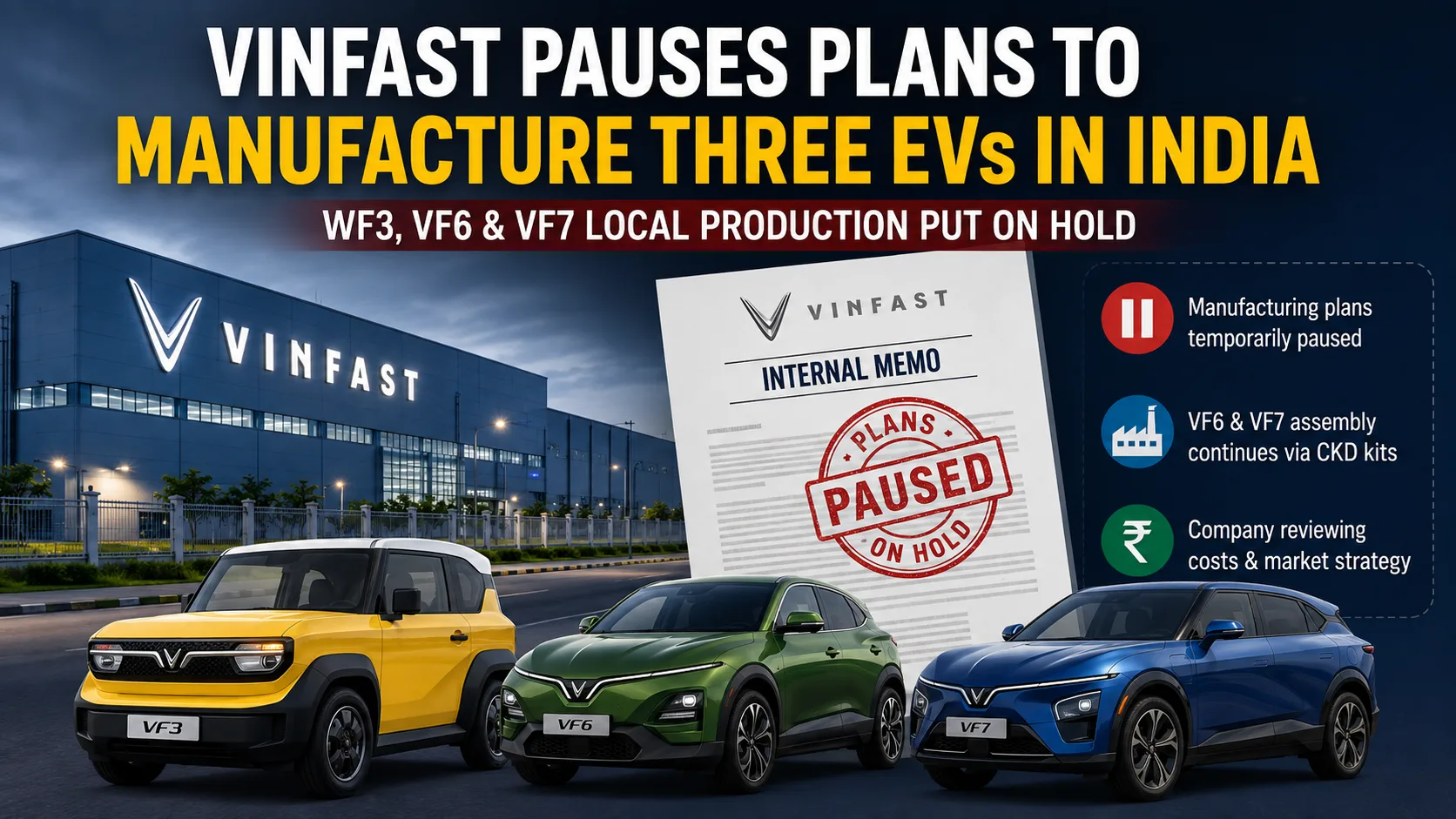
Vietnamese electric vehicle maker VinFast has temporarily suspended plans to manufacture three of its electric cars—the VF3, VF6, and VF7—locally in India, according to an internal company memo and sources cited in a Reuters report.
The development comes roughly a year after the automaker launched operations in the country and established a major manufacturing base in Tamil Nadu. While VinFast initially outlined ambitious local expansion targets, it is now reassessing component costs. Company representatives have maintained that India remains a central pillar of its long-term growth plans.
VinFast Pauses Local Manufacturing Plans
Under the temporary directive, VinFast has asked domestic suppliers involved in the three vehicle programs to halt development work and provide itemized expense reports for potential reimbursement.
According to sources, the decision was triggered after local component development costs exceeded targeted budgets. Deeper local manufacturing was strategically important for VinFast to bypass steep import taxes and offer competitive price points in India’s price-sensitive electric vehicle market. Importantly, this pause does not signal a shutdown of VinFast’s Indian presence.
VF6 and VF7 Production Continues via CKD Kits?
A critical distinction must be made regarding VinFast’s manufacturing footprint: the company is not closing its facility or stopping vehicle rollouts in India. Instead, it continues to assemble the VF6 compact SUV and VF7 mid-size SUV at its Tamil Nadu plant using imported Completely Knocked Down (CKD) kits.
Unlike deep localization—where components are built locally from scratch—CKD assembly involves putting together pre-fabricated component kits imported directly from Vietnam.
Why VinFast India Manufacturing Is Being Reassessed?
The decision to pause full component localization stems from several market realities:
Manufacturing Costs: Component development expenses missed initial budget targets.
Market Competition: Fierce price competition from established Indian and international EV manufacturers.
Economies of Scale: Reaching volumes necessary to justify domestic supplier tooling remains challenging in the early growth phase.
Responding to the development, VinFast stated that it is adjusting its product strategy based on ongoing market research and feedback from Indian consumers.
VinFast Tamil Nadu Plant and Investment Context?
This strategic pause comes after VinFast committed to an extensive $2 billion VinFast India investment plan, establishing an EV facility in Thoothukudi, Tamil Nadu.
Designed as a regional hub for South Asia and export markets, the plant retains an initial capacity of 50,000 units annually. None of the report’s details indicate that VinFast is abandoning its total investment commitment.
VF3, VF6, and VF7: What Lies Ahead?
The three affected models represent core pillars of the brand’s portfolio—the small two-door VF3 city car, the compact VF6 SUV, and the larger VF7 SUV. While local manufacturing for these models is on hold, they remain relevant to VinFast electric cars India strategy, as assembly of the VF6 and VF7 proceeds via imported kits.
Sales Scale and Market Challenges
With total Indian sales standing at around 10,000 units to date—including fleet deliveries to affiliated ride-hailing firm Green SM VinFast faces the task of scaling up volume. Higher retail volume is essential for spreading fixed manufacturing and local vendor setup costs.
Also Read: Spied: Renault Triber Turbo CNG Hints at More Power and Practicality
What This Means for VinFast India?
Ultimately, the latest move represents a strategic recalibration rather than an exit. In summary:
VinFast continues operating its Tamil Nadu manufacturing plant.
Assembly of the VF6 and VF7 via CKD kits remains active.
Deep component localization is temporarily paused while costs and market demands are re-evaluated.
The upcoming months will reveal whether VinFast resumes deeper local sourcing or shifts toward developing bespoke, India-specific EV models.


