The Great Transition: Is the Diesel SUV Segment in India Approaching Its End?
For decades, the diesel SUV has been the undisputed king of Indian roads. Defined by relentless low-end torque, effortless highway cruising, and superior fuel economy, diesel engines have provided the rugged appeal necessary for India’s diverse topography.
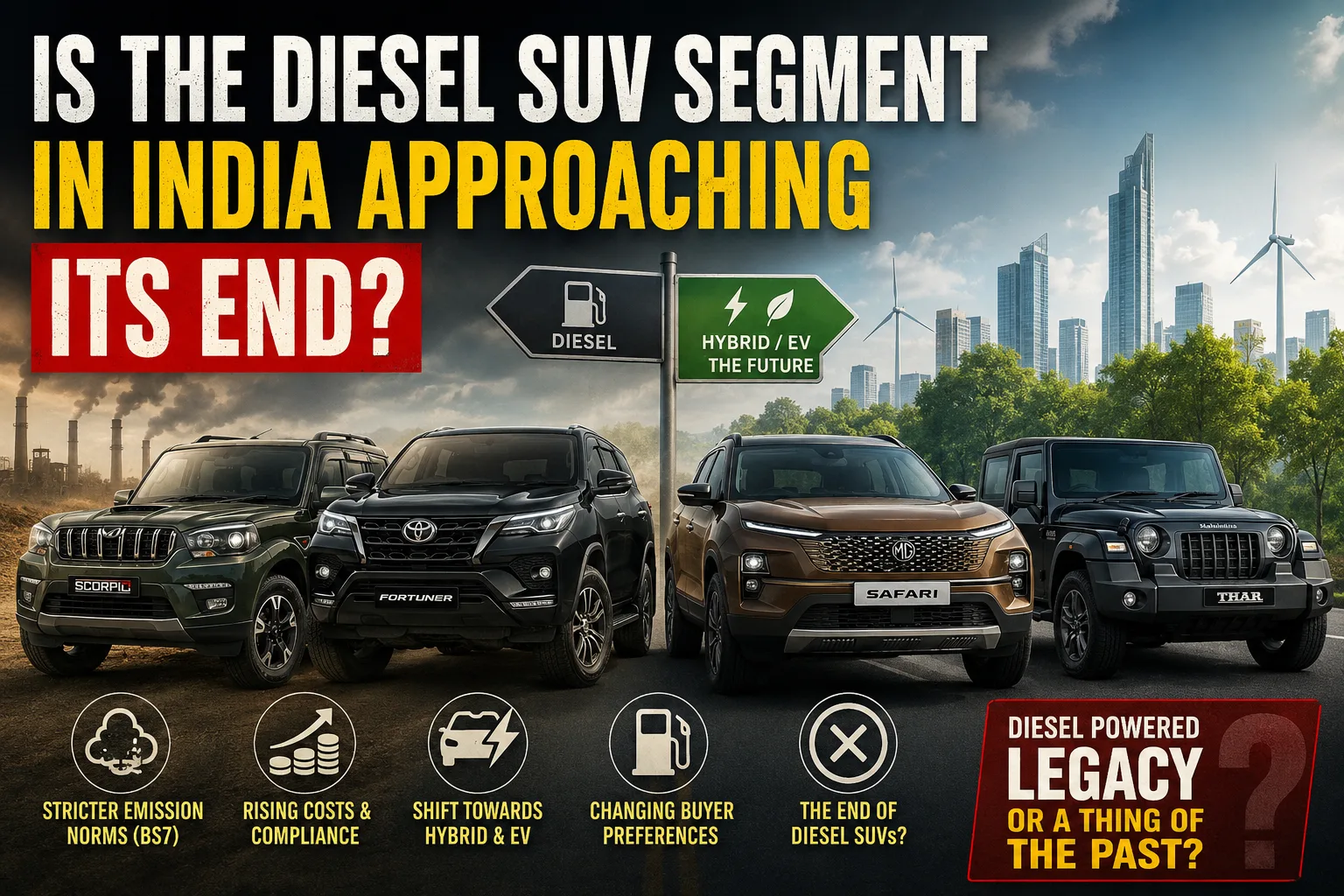
Iconic models like the Mahindra Scorpio N, Toyota Fortuner, and Mahindra Thar, alongside premium offerings like the Tata Safari and Hyundai Alcazar, continue to draw thousands of buyers from both bustling urban centers and remote rural outposts.
However, the landscape is shifting. As stricter emission regulations loom, compliance costs skyrocket, and the rapid expansion of hybrid and electric vehicle (EV) ecosystems gains momentum, a critical question arises: Are we witnessing the final chapter of the diesel SUV era in India?

Torque and Tradition: Why Diesel SUVs Still Command the Market
Despite the near-total disappearance of diesel engines from the hatchback and sedan segments, SUVs have remained a steadfast stronghold for the fuel type. In recent years, the diesel passenger vehicle market share has stabilized at approximately 18%, largely buoyed by SUV enthusiasts who demand the unique drivability that only oil-burners provide.
The preference is driven by the necessity for strong torque delivery and long-distance endurance—factors where petrol engines often fall short in heavy-bodied vehicles. Currently, Mahindra & Mahindra dominates this space; in FY2026, models such as the Scorpio, Bolero, XUV700, and Thar accounted for a commanding portion of India’s total diesel SUV sales, proving that for a significant demographic, diesel is still the primary choice.
The Compliance Wall: The Looming Impact of BS7 Norms
The most formidable hurdle for the segment is the impending arrival of BS7 (Bharat Stage 7) emission norms. These stricter regulations are set to force automakers to implement even more complex and expensive exhaust after-treatment systems.
Industry experts estimate that making diesel SUVs BS7-compliant could hike prices by anywhere from ₹30,000 to over ₹1 lakh, depending on the engine displacement and vehicle segment. Such a steep price increase could prove catastrophic in the highly competitive ₹10 lakh–₹25 lakh price bracket, where buyers are notoriously price-sensitive.
As the price gap between petrol, hybrid, and diesel narrows, the economic rationale for choosing diesel begins to evaporate for the average consumer.
Shifting Gears: How Automakers are Pivoting Strategies
In anticipation of this regulatory squeeze, manufacturers are pivotally shifting their long-term strategies. Toyota, once the vocal champion of large diesel engines, is increasingly leaning into its Strong Hybrid technology to bridge the gap.
Tata Motors has taken a different route, aggressively expanding its EV and CNG portfolios to offer high-torque alternatives.
Even Mahindra, while still heavily reliant on its current diesel lineup, is funneling massive investments into electric SUVs (the XUV.e and BE brands) and developing hybrid-ready platforms to future-proof its business. Similarly, Hyundai and Kia are diversifying their portfolios with turbo-petrol and hybrid units, signaling a gradual retreat from total diesel dependency.
The Resilience of the Oil-Burner: Why Diesel Isn’t Dead Yet
Despite these challenges, it would be premature to write an obituary for the diesel SUV just yet. Several high-profile launches are still on the horizon, including the next-generation Toyota Fortuner, an updated Mahindra Scorpio N, and the MG Majestor, alongside new diesel-powered variants from Kia.
The reality is that for customers who frequently cover long distances, tow heavy loads, or engage in serious off-roading, diesel remains the most practical and reliable tool for the job.
Its thermal efficiency and mechanical robustness under heavy load are characteristics that current EV and petrol technologies struggle to replicate at a similar price-to-utility ratio.
The Hybrid and EV Surge: Changing Buyer Behavior
However, the competition is no longer just internal. The rise of Strong Hybrids, EVs, and high-performance CNG vehicles is fundamentally altering buyer behavior.
Improved charging infrastructure and government incentives like FAME are making EVs more viable, while hybrids are being positioned as the “cleaner diesel” for urban markets, offering high efficiency without the range anxiety.
Furthermore, stringent regional regulations—most notably the 10-year diesel rule in Delhi-NCR—and growing environmental consciousness are accelerating the shift in major metropolitan hubs, where diesel was once a status symbol.
Market Sentiment: Resale Value and Future Uncertainty
Among the enthusiast community and on platforms like Team-BHP.com, sentiment remains divided. While purists argue that diesel offers unmatched highway performance and longevity for large frames, a growing sense of anxiety prevails.
Online discussions are increasingly dominated by concerns regarding future resale value, potential bans in more cities, and the long-term availability of parts as the industry pivots. For many, the risk of a “stranded asset” is becoming a significant deterrent, even if they prefer the diesel driving experience.
Conclusion: A Segment in Transition
Ultimately, while diesel SUVs are far from disappearing overnight, the segment is clearly entering a transformative transition phase. The next few years will serve as a litmus test for the industry.
Whether diesel continues to thrive as a niche choice for premium SUVs and rural workhorses, or slowly fades away in favor of hybrid and electric alternatives, will depend on how successfully manufacturers can balance the cost of compliance with the evolving demands of the Indian motorist. For now, the “Diesel King” still wears the crown, but the throne is looking increasingly precarious.
Also Read: Hyundai Cars Get Massive Discounts In May 2026 – Creta, Verna, i20, Exter & More