
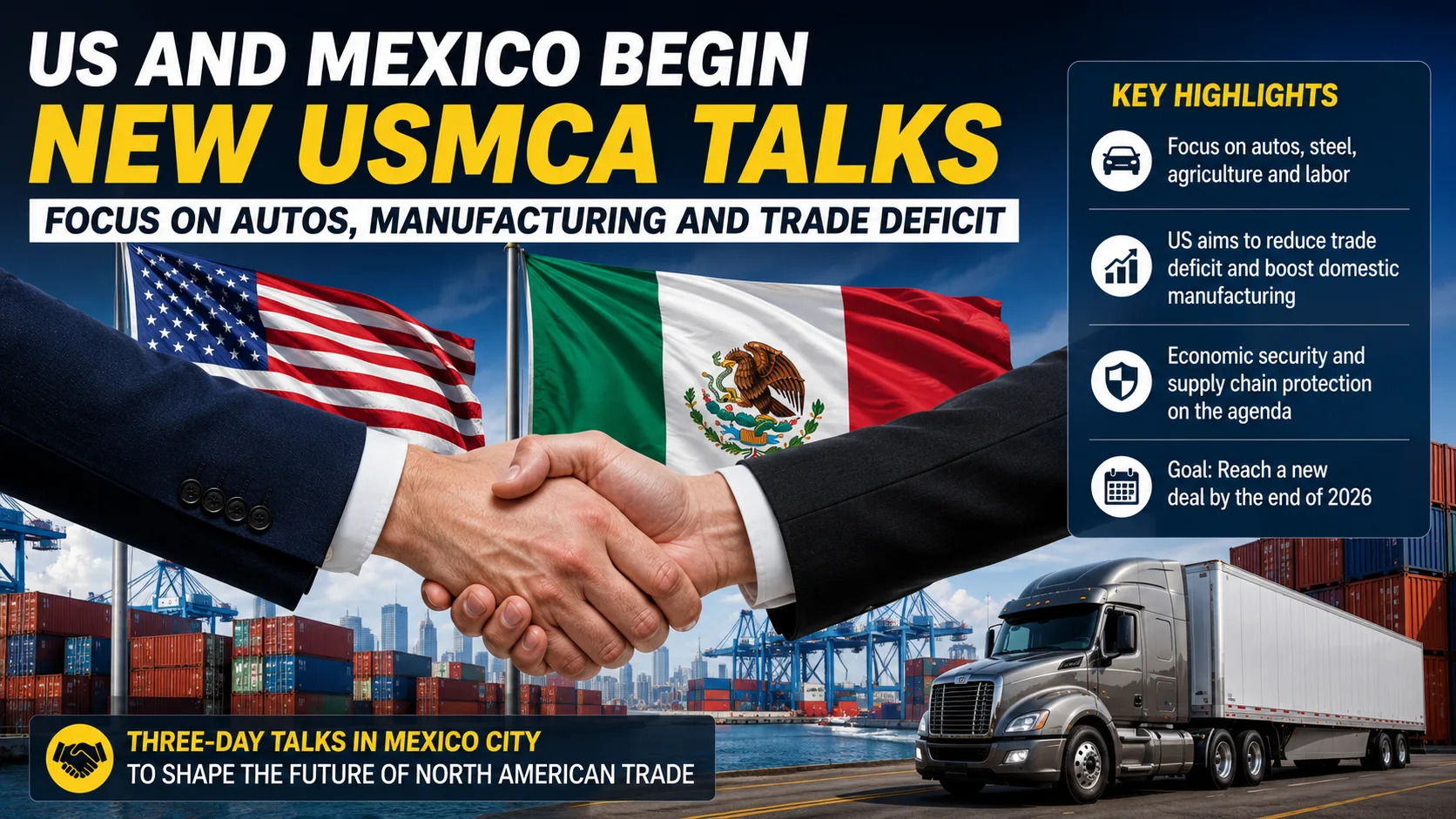
US and Mexico Launch New USMCA Talks Amid Auto Manufacturing Push
The United States and Mexico have begun a fresh round of negotiations to reshape the future of the United States-Mexico-Canada Agreement (USMCA), with the automobile sector emerging as one of the biggest areas of discussion.
The three-day meeting in Mexico City comes at a crucial time after the Trump administration decided not to extend the six-year-old trade pact earlier this month, setting the stage for a possible overhaul of North America’s trade framework.
The talks also coincide with Washington’s announcement of new tariffs on Canadian goods, adding further complexity to regional trade relations.
Why The New USMCA Talks Matter
The latest negotiations are taking place exclusively between the United States and Mexico, with Canada not participating in this round. Since the USMCA was not renewed on July 1, the agreement has entered a transition period that could eventually lead to its expiration within the next decade unless all three member nations agree on revised terms.
Business groups have urged policymakers to preserve the agreement’s tariff-free trade structure, arguing that it provides certainty for companies operating across North America and supports nearly $1.6 trillion in regional trade.
Trump Administration Wants More Manufacturing In The US
A major objective of the Trump administration is to reduce America’s trade deficit with both Mexico and Canada while encouraging manufacturers to move production back to the United States.
US Trade Representative Jamieson Greer has said the administration wants future trade rules to promote higher levels of North American production, particularly in the automotive sector. One proposal under discussion would require 50 percent of the value of vehicles built in North America to originate from the United States, a significant change from the current rules.
Such a move could force global automakers to rethink their manufacturing strategies and supply chains across the region.
Automakers Already Adjusting Their Production Plans
Several manufacturers have already started responding to changing trade policies.
Toyota is expanding truck production at its Texas facility, while General Motors has announced plans to shift the production of two Chevrolet SUV models from Mexico to the United States beginning in 2027. GM expects these changes to increase its costs by nearly $1.5 billion this year but views the move as part of its long-term manufacturing strategy.
These developments indicate that trade policy is already influencing investment decisions across the automotive industry.
China’s Growing Presence Could Shape The Negotiations
Another important topic expected to dominate the discussions is China’s increasing influence in North America’s automotive market.
US officials are reportedly seeking stronger regional trade protections to prevent Chinese companies from using Mexico or Canada as gateways to access the US market under preferential trade terms. The issue has gained attention after Chinese automakers continued to expand rapidly in Mexico despite higher import tariffs introduced earlier this year.
Also Read: Yamaha to Launch New Electric Scooter in India
What Happens Next?
Mexican officials remain optimistic about reaching a revised trade agreement before the end of the year. Both governments have indicated that strengthening North American manufacturing, improving supply chain resilience and increasing regional investment remain common priorities.
As negotiations continue, the outcome could have a significant impact on automakers, suppliers and consumers across North America, potentially reshaping the region’s automotive industry for years to come.
Also Read: Is JSW Motors Buying a Major Stake in Volkswagen India? Here’s What We Know