Existing BMW Cars Won’t Support E30 Ethanol Fuel? Here’s Why BMW Owners May Not Get An Upgrade
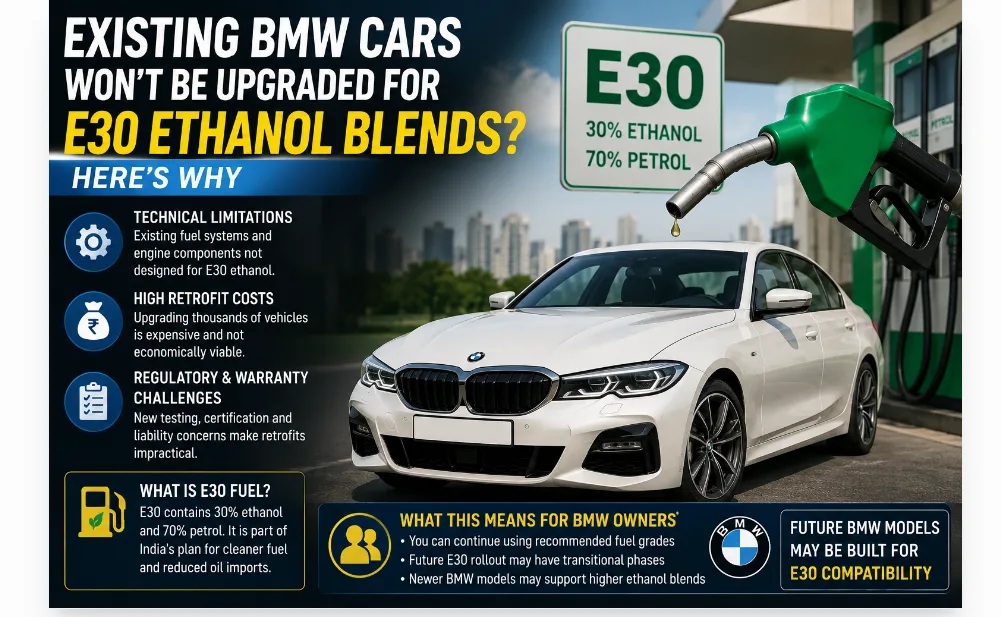
As India accelerates its ethanol-blending program, many car owners are wondering whether their existing vehicles will be compatible with future E30 fuel. Luxury carmaker BMW has recently clarified that it does not plan to upgrade its existing petrol-powered models for E30 compatibility.
While the company fully supports India’s progressive green energy roadmap, retrofitting older vehicles presents several severe engineering and regulatory challenges.
This decision could affect thousands of BMW owners across the country, who may eventually need to rely on lower ethanol blends or purchase newer, factory-ready E30-compatible models. This development highlights the complex balance between country-wide environmental goals and mechanical realities.
What Is E30 Fuel?
E30 petrol contains a blend of 30% ethanol and 70% conventional petrol. As part of the Indian government’s aggressive ethanol-blending program, the Bureau of Indian Standards (BIS) recently notified standards for higher blends like E22, E25, and E30.
The primary objective behind pushing for high-concentration ethanol fuel India is to slash the country’s massive crude oil import bills.
Additionally, E30 fuel benefits the environment by ensuring lower carbon emissions and promoting cleaner combustion, turning domestic agricultural surplus into a vital biofuel.
Why Existing BMW Cars Cannot Be Upgraded
Adapting older luxury cars to high ethanol levels is not as simple as a quick software patch. There are deep technical reasons why existing BMW petrol cars India cannot be retrofitted:
Material Degradation: Ethanol is highly corrosive compared to standard petrol. Fuel system components on older cars—including fuel lines, rubber seals, injectors, and fuel pumps—were engineered for lower ethanol blends (like E10 or E20). Constant exposure to E30 would accelerate component wear and cause leaks.
Mechanical Calibration: Higher ethanol blends have a lower energy density, requiring complex engine calibration changes.
Reliability Risks: Modifying the ECU software without upgrading the physical engine internals poses a massive threat to long-term durability and powertrain reliability.
Cost And Regulatory Challenges
Beyond the complex engineering, structural retrofitting comes with heavy commercial hurdles. Redesigning and replacing fuel systems across thousands of older luxury vehicles is not economically viable for manufacturers.
Furthermore, a BMW fuel upgrade of this scale would demand entirely new testing, vehicle certification, and emissions compliance approvals from regulatory bodies. Navigating warranty liabilities and strict manufacturer compliance makes a post-sale upgrade program nearly impossible to execute.
What Does This Mean For BMW Owners?
For current owners, there is no immediate reason to panic. Existing BMW petrol cars India can safely continue running on current, manufacturer-approved fuel grades like E10 or E20.
The future rollout of E30 petrol India will likely feature transitional phases where regular fuel remain widely available. BMW owners should always strictly adhere to the specific fuel recommendations outlined in their user manuals to avoid voiding warranties or damaging their engines.
Will Future BMW Models Support E30?
Yes, future product development will naturally evolve alongside local regulations. BMW is already planning its upcoming lineup to ensure complete compliance with India’s evolving fuel mandates, paving the way for factory-fresh BMW flex fuel engines capable of safely handling higher ethanol concentrations without breaking a sweat.
Also Read: Tata Sierra EV Teased Ahead Of Launch: 5 Reasons Why You Should Consider Buying It
Conclusion
BMW’s stance underscores the intense friction of adapting high-performance modern engines to aggressive bio-fuel blends. While future BMW models will be engineered to support E30 fuel right out of the factory, existing vehicles are unlikely to receive aftermarket upgrades due to technical, regulatory, and economic barriers.
Current owners should continue utilizing manufacturer-recommended fuel specifications to ensure maximum engine life.
Also Read: MV Agusta Brutale RR Ottantesimo Unveiled: Limited To Just 500 Units Worldwide