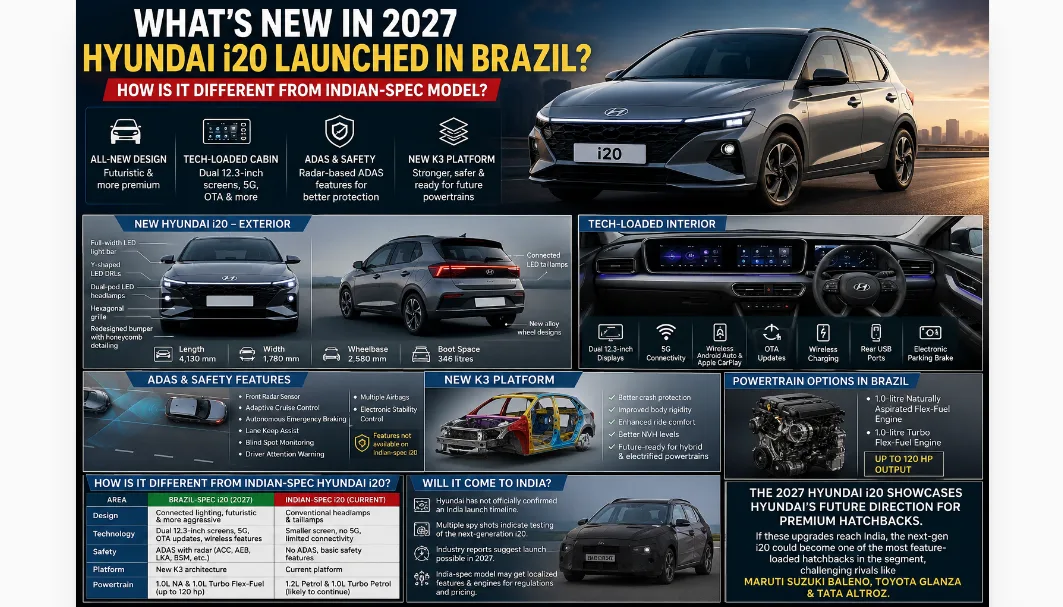
What’s New in 2027 Hyundai i20 Launched in Brazil? How Is It Different From the Indian-Spec Model?
Hyundai has officially unveiled the all-new fourth-generation Hyundai i20 in Brazil, marking a monumental shift for the popular premium hatchback.
Positioned to redefine its segment, this Brazilian-spec model previews the future of Hyundai’s premium hatchback lineup globally and provides critical clues about the next-generation i20 expected to arrive in India.
Moving away from the low-slung, rounded appearance of its predecessor, the new model gets a radical design overhaul that edges it closer to a futuristic crossover stance.
Built on an entirely new platform, the fourth-gen hatchback is packed with next-generation technology, highly advanced safety features, and a sophisticated Level 2 ADAS suite, making it a true marvel of modern automotive engineering.
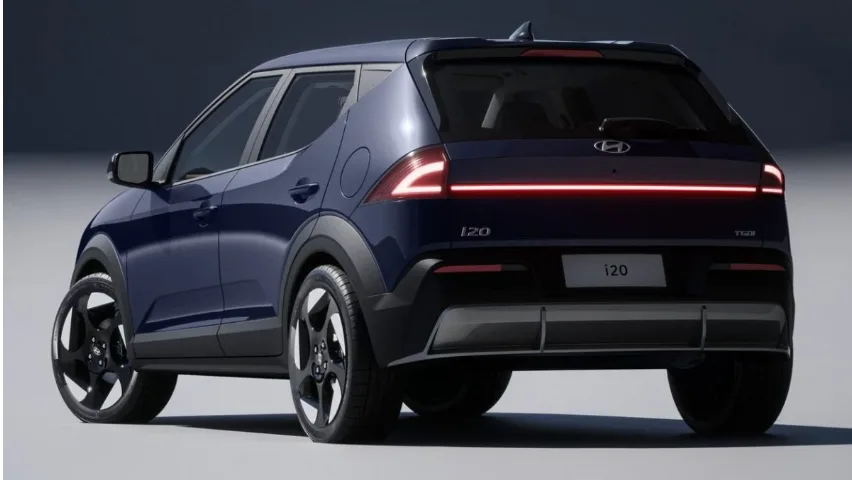
New Hyundai i20 Gets Completely New Design
The exterior of the 2027 Hyundai i20 moves away from the sharp, low cuts of the current model in favor of a mature, upright, and crossover-inspired aesthetic.
The front fascia is dominated by a bold, wider hexagonal grille featuring intricate detailing, bordered by distinct dual-pod LED headlamps.
Giving it an unmistakable presence is a full-width LED light bar that seamlessly connects the sharp, Y-shaped LED daytime running lights (DRLs).
A completely redesigned bumper with prominent honeycomb detailing and a blacked-out lower section gives the nose a highly aggressive stance.
Along the side profile, the i20 looks noticeably more substantial. It sports a sportier silhouette with a sharply raked window line, pronounced wheel arches adorned with thick black body cladding, and striking 17-inch diamond-cut alloy wheels.
The rear is equally futuristic, featuring a sculpted tailgate, a sleek roof spoiler, and a chunky rear bumper with a faux silver diffuser.
Mirroring the front, the rear is highlighted by a sharp connected LED taillamp setup stretching across the tailgate.
Key Dimensions Comparison
The fourth-generation hatchback has grown significantly in its footprint, enhancing its road presence and cabin space.
Length: 4,130 mm
Width: 1,780 mm
Wheelbase: 2,580 mm
Boot Space: 346 litres
Compared to the current third-generation i20 sold in India, which is artificially restricted to under 4 meters to save on taxes, the Brazilian model is much longer and wider. This gives it a significantly more premium and imposing road presence than the current Indian variant.
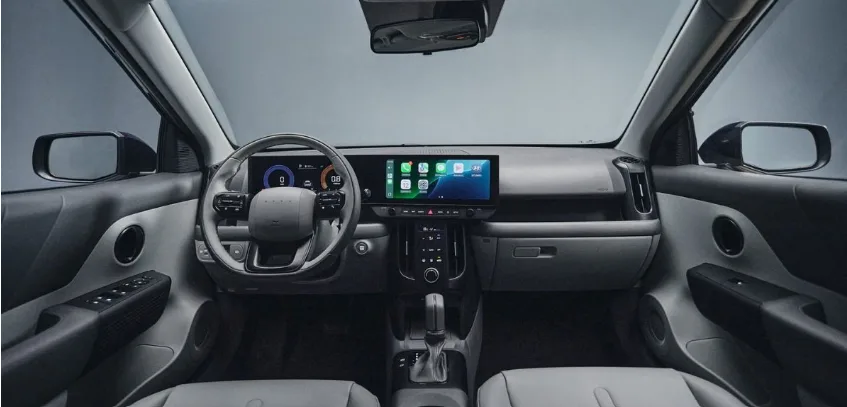
Brand-New Cabin Loaded With Technology
Step inside, and the cabin of the 2027 Hyundai i20 represents a generational leap over the current Indian-spec model. The dashboard features a completely new, cleaner layout utilizing high-quality materials and multiple sophisticated dual-tone color themes.
The undisputed centerpiece of the interior is a massive, premium curved panel housing a dual 12.3-inch screen setup. This integrates a fully digital instrument cluster for the driver and a highly responsive infotainment touchscreen system.
The setup comes built-in with 5G connectivity support, enabling lightning-fast responses and seamless over-the-air (OTA) software updates.
Comfort and convenience are further elevated by a comprehensive list of premium features:
Wireless Android Auto and Apple CarPlay
Wireless smartphone charging pad
Front and rear USB Type-C charging ports
An Electronic Parking Brake (EPB) with Auto-Hold functionality
Sleek vertical air conditioning vents with touch-sensitive climate controls
This tech-focused environment feels light-years ahead of the existing Indian-spec i20, bringing a luxury-class experience to the premium hatchback segment.
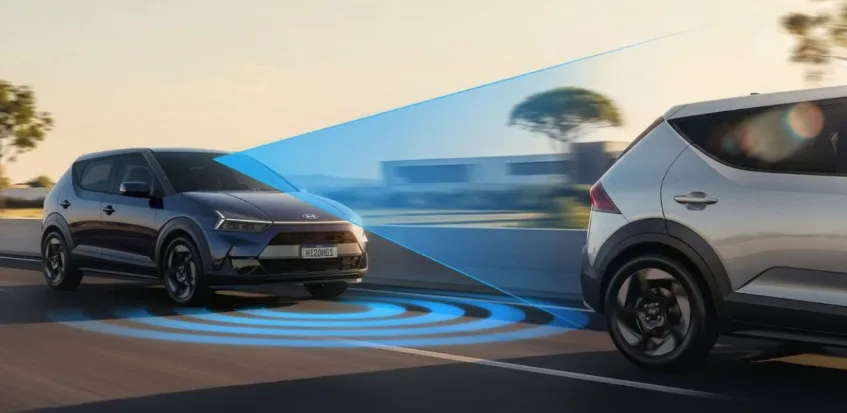
ADAS and Safety Features
Safety takes center stage in the fourth-generation Hyundai i20. The vehicle comes equipped with Hyundai’s advanced SmartSense Level 2 ADAS (Advanced Driver Assistance Systems) suite, which uses a front radar sensor and cameras to actively protect occupants.
Key safety technologies included in the premium package are:
Adaptive Cruise Control
Autonomous Emergency Braking (Forward Collision Avoidance Assist)
Lane Keep Assist and Lane Following Assist
Blind Spot Monitoring and Collision Avoidance
Driver Attention Warning
Leading Vehicle Departure Alert
In addition to these active driver aids, the hatchback ensures robust passive protection with six airbags as standard, Electronic Stability Control (ESC), Vehicle Stability Management (VSM), Hill Start Assist, and a Tyre Pressure Monitoring System (TPMS).
Crucially, radar-based ADAS and an electronic parking brake are missing entirely from the current Indian-spec i20 range, highlighting how advanced the Brazilian version truly is.
New Platform and Improved Structural Rigidity
Underneath the striking sheet metal, the Brazilian-spec 2027 Hyundai i20 transitions to the automaker’s latest third-generation K3 architecture. This modular platform uses a significantly higher proportion of advanced high-strength steel compared to the older platform.
The benefits of the K3 platform include:
Better Crash Protection: Designed to absorb and redirect impact energy more effectively, keeping the cabin intact during collisions.
Improved Body Rigidity: Torsional stiffness is greatly improved, aiding sharper handling and long-term durability.
Enhanced Ride Comfort: The sophisticated chassis tuning reduces body roll and handles bad patches of road gracefully.
Better NVH Levels: Noise, vibration, and harshness are heavily suppressed, ensuring a whisper-quiet cabin experience.
By upgrading to this platform, Hyundai aims to drastically improve safety ratings globally, proving that premium hatchbacks can offer structural safety on par with mid-size SUVs. Furthermore, the K3 architecture is future-ready, possessing the layout flexibility to comfortably support hybrid and electrified powertrains.
Powertrain Options in Brazil
To comply with local automotive demands and Brazil’s highly strict ethanol-blended fuel regulations, the new i20 is launched with two distinct three-cylinder engine options:
1.0-litre Naturally Aspirated Flex-Fuel Engine: Tuning out up to 80 hp and 100 Nm of torque, mated to a 5-speed manual gearbox.
1.0-litre TGDi Turbo Flex-Fuel Engine: Developing a robust 115 hp and 172 Nm of torque, paired with a 6-speed automatic or manual transmission.
Because Brazil relies heavily on biofuel, these engines are engineered to run seamlessly on pure ethanol, E30 petrol, or any mixture of the two.
This flex-fuel capability requires specific fuel injectors and engine mapping, differing substantially from the standard petrol setups used in alternative Asian and European markets.
How Is It Different From The Indian-Spec Hyundai i20?
While sharing a nameplate, the newly launched Brazilian model and the current Indian-spec hatchback are distinctly different vehicles across multiple spectrums:
| Feature | Brazilian-Spec Hyundai i20 (4th Gen) | Indian-Spec Hyundai i20 (Current Gen) |
| Design & Style | Futuristic, crossover-inspired, full-width front/rear connected LED lighting setup. | Sharp, sporty, low-slung stance with traditional non-connected lighting. |
| Dimensions | 4,130 mm long; larger road presence and 346-litre boot. | Under 4,000 mm long to meet sub-4m tax regulations; 311-litre boot. |
| Technology | Dual 12.3-inch curved screens, 5G chip connectivity, and OTA support. | Split 10.25-inch infotainment screen and digital cluster; no 5G. |
| Safety | Level 2 ADAS package (Radar + Camera), Electronic Parking Brake. | Basic safety features; lacks radar-based driver assistance and EPB. |
| Platform | Advanced K3 Modular Architecture. | Older K2 Platform. |
| Powertrain | 1.0L NA & 1.0L Turbo flex-fuel engines (up to 115 hp). | 1.2L NA Petrol (83/88 hp) and 1.0L Turbo Petrol (120 hp for N Line). |
Will This New Hyundai i20 Come To India?
Hyundai India has not officially confirmed a concrete launch timeline for the fourth-generation i20. However, the premium hatchback segment remains a vital volume-generator for the brand.
Multiple spy shots of heavily camouflaged test mules on Indian roads indicate that local testing activities linked to the next-generation i20 are already underway.
Industry reports strongly suggest that the all-new model could make its official debut in India during mid-to-late 2027. To comply with India’s strict tax structures and keep pricing highly competitive, the India-spec version will likely undergo structural alterations to trim its length down to under 4 meters.
Furthermore, it will feature localized equipment and carry forward the highly reliable 1.2-litre Kappa petrol engine alongside the 1.0-litre turbo-petrol engine.
Conclusion
The newly launched Brazil-spec Hyundai i20 beautifully showcases the brand’s bold vision for the future of premium hatchbacks. By blending high-end tech, crossover styling, and robust safety through the K3 platform, Hyundai has raised the bar.
If the Korean automaker manages to bring the majority of these comprehensive upgrades to the Indian market in 2027—even with sub-4m structural adjustments—the next-generation i20 will confidently crown itself as the most feature-loaded premium hatchback in the country.
It will undoubtedly pose a serious threat to long-standing segment rivals like the Maruti Suzuki Baleno, Toyota Glanza, and Tata Altroz.