Tata Sierra EV vs Mahindra BE 6E: Which Electric SUV Is the Best Choice for You and Why?
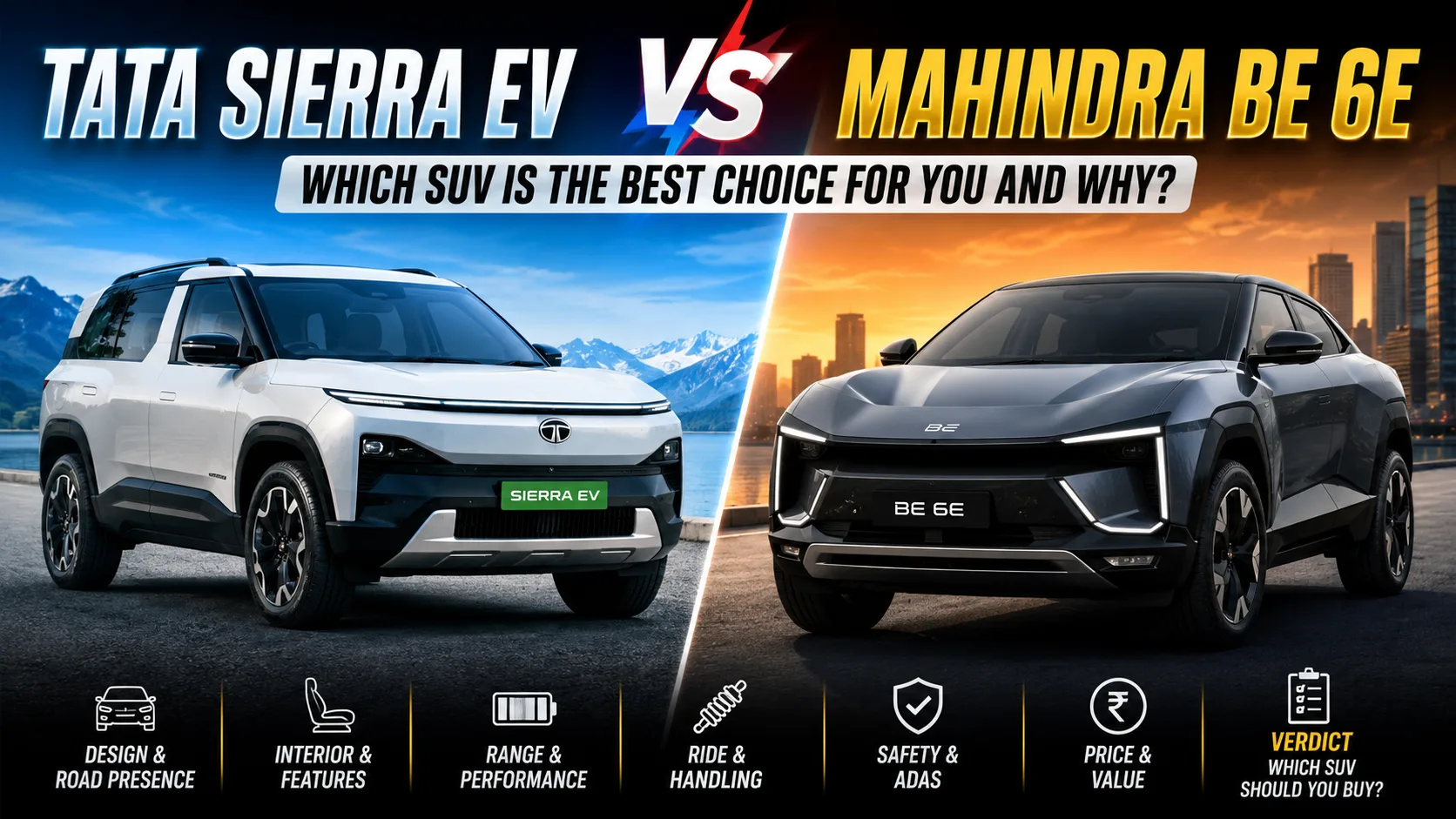
Tata Sierra EV vs Mahindra BE 6E: The Indian electric vehicle market is witnessing its most explosive phase yet. Long gone are the days when EV buyers had to settle for retrofitted internal combustion engine (ICE) platforms with compromised spacing. In 2026, the mid-size premium electric SUV segment has transformed into a high-stakes battleground. Leading this massive transition are two heavyweights: the newly launched Tata Sierra EV and the radical Mahindra BE 6e (frequently searched as the BE 6).
Both indigenous automakers are targeting the Rs. 18 Lakh to Rs. 28 Lakh price bracket, directly challenging traditional mid-size ICE SUVs and incoming global EV entries. While Tata leans heavily on heritage nostalgia blended with a modular, rugged architecture, Mahindra takes a bold leap into the future with a dedicated “born electric” platform.
Choosing the best electric SUV in India for 2026 comes down to understanding your specific driving profile. This detailed comparison buyer’s guide breaks down design, performance, real-world range, cabin tech, and long-term value to help you make the perfect decision.
Tata Sierra EV vs Mahindra BE 6E: Design and Road Presence
The styling philosophies of these two SUVs couldn’t be more distinct. Tata has taken a sophisticated, neo-retro approach, while Mahindra aims for an aggressive, sci-fi aesthetic.
Tata Sierra EV: Retaining the Living Legend
Tata Motors has masterfully reincarnated the iconic 1990s Sierra silhouette for the electric age. Built on the acti.ev+ architecture, it maintains a commanding, upright stance with a straight roofline and the signature panoramic-style rear glasshouse area.
Key elements include a completely blanked-off aerodynamic front grille, sleek full-width connected LED DRLs, flush-fitting door handles, and chunky aero-optimized 19-inch alloy wheels. It commands absolute respect with a clean, understated, and rugged “proper SUV” look that balances nostalgia with modern luxury.
Mahindra BE 6e: The Athletic Crossover Coupe
The Mahindra BE 6e is the first vehicle born from the ground-up INGLO electric architecture. It is an outright head-turner that looks like a concept car pulled straight out of a video game.
Key elements include edgy, angular body panels, heavily sculpted wheel arches, a radically sloping coupe roofline, and prominent C-shaped matrix LED lighting signatures. It is ultra-futuristic, low-slung, and aggressive—blurring the line between a sharp sport crossover and a muscular high-riding fastback.
Interior, Comfort, and Features
Step inside, and the structural differences between a modified EV architecture and a dedicated skateboard platform become immediately apparent.
Dashboard Design & Cockpit Tech
The Tata Sierra EV opts for a premium, multi-layered dashboard layout. High-spec variants introduce a premium triple-screen layout consisting of a digital cockpit for the driver, a massive 12.3-inch central touchscreen running custom Android Automotive software, and a dedicated co-passenger display. The system runs seamlessly, backed by an augmented reality Head-Up Display (HUD) and a JBL audio system with Dolby Atmos.
The Mahindra BE 6e focuses entirely on the driver with a dramatic wraparound cockpit divided by a prominent physical spine. It features twin 12.3-inch integrated floating high-definition screens powered by the Qualcomm Snapdragon 8295 chipset running Mahindra’s proprietary MAIA AI OS. Combined with aircraft-style physical toggle switches and a Harman Kardon premium audio system, the BE 6e feels decidedly sporty.
Comfort, Space, and Practicality
For families, the Tata Sierra EV stands out as highly accommodating. Its boxy shape yields massive headroom, a perfectly flat rear floor, wide door openings, and a generous 480-litre boot capacity. Top trims even feature a rear lounge seat configuration that maximizes legroom and comfort.
The athletic coupe styling of the Mahindra BE 6e demands some compromises. The rear seat floor is relatively high due to the under-floor battery packs, creating a slightly knees-up seating position. Rear headroom is snug for taller passengers, the rear windows feel small, and the boot capacity sits at a slightly lower 455 litres.
Battery, Range, and Performance
When analyzing the Mahindra BE 6e specs against the Tata Sierra EV range and features, it’s clear both manufacturers have brought their absolute best powertrain technology to the table.
Powertrain & Acceleration
Mahindra leverages its Formula E learnings to give the BE 6e serious performance credentials. Driven by a high-power rear-wheel-drive (RWD) permanent magnet synchronous motor, it produces up to 282 bhp and 380 Nm of torque in its peak 79 kWh trim, rocketing from 0 to 100 km/h in a sports-car-rivaling 6.7 seconds.
Tata counters with a highly efficient powertrain strategy. While standard trims use a front-wheel-drive setup, the Sierra EV introduces a headline-grabbing QWD Dual Motor All-Wheel Drive (AWD) system on its top-tier variants. This dual-motor layout grants the Sierra supreme mechanical grip and independent terrain modes (Snow, Rain, Sand) for mild off-roading.
Battery Capacity & Real-World Driving Range
The Tata Sierra EV offers 65 kWh and 75 kWh advanced LFP battery packs. The highly optimized e-drive setup translates to an official MIDC range of over 600 km, resulting in a reliable 460 to 510 km of real-world range on a full charge.
The Mahindra BE 6e features 59 kWh and 79 kWh battery choices. The larger 79 kWh pack boasts a certified MIDC range of up to 683 km. In real-world highway and city conditions, expect a stellar 480 to 530 km of range, though spirited driving will deplete it quicker.
Charging Infrastructure Compatibility
Mahindra takes the lead in charging speeds thanks to its INGLO architecture’s high-power compatibility. It can juice up from 20% to 80% in just 20 minutes using a 175 kW DC fast charger. The Sierra EV supports up to 100 kW DC fast charging, hitting the standard 10% to 80% mark in roughly 40 minutes. Both come with 7.2 kW and 11.2 kW AC wall box options for home charging.
Ride and Handling
The driving dynamics closely follow the aesthetic vibe of each car.
In terms of city usability, the Sierra EV offers exceptional outward visibility with light, effortless steering that makes navigating urban traffic a breeze. The BE 6e has a wider footprint and heavier steering feel at parking speeds, combined with restricted rear visibility that relies heavily on its 360-degree camera system.
For highway stability and suspension performance, Mahindra equips the BE 6e with an advanced 5-link independent rear suspension and Intelligent Semi-Active Dampers. It stays glued to the tarmac at high speeds with minimal body roll. The Sierra EV is tuned more for plush ride comfort; it rounds off sharp road edges beautifully but exhibits traditional SUV lean around fast corners.
Safety Features
Both brands have built their reputations on robust safety, and their 2026 EV flagship products are engineered to secure top honors.
The BE 6e’s INGLO architecture features ultra-high-strength steel reinforcing the under-floor battery casing. Tata’s acti.ev+ uses a heavily reinforced frame designed for optimal crash load distribution. Both vehicles are explicitly engineered to target 5-Star Bharat NCAP safety ratings.
For driving assistance, Mahindra implements a Level 2+ Advanced Driver Assistance System powered by the Mobileye EyeQ6 chip, utilizing an 8 MP camera for hyper-precise lane-keeping and emergency braking. Tata features a comprehensive Level 2 ADAS suite perfectly calibrated for chaotic Indian road conditions, complete with adaptive cruise control, blind-spot monitoring, and rear cross-traffic alerts.
Pricing and Value Proposition
The upcoming electric SUVs India segment is highly price-sensitive, and both brands have priced their vehicles competitively to capture market share.
The Mahindra BE 6e price range spans from Rs. 18.90 Lakh to Rs. 28.49 Lakh (Ex-Showroom). Mahindra utilizes a multi-tier variant structure (Pack One to Pack Three along with limited Formula and Batman editions). Crucially, Mahindra offers a lifetime battery warranty for the first registered private owner, drastically lowering long-term ownership anxieties.
The Tata Sierra EV price range launches starting at Rs. 18.79 Lakh (Ex-Showroom) for the base Pure trim, extending up to Rs. 25.50 Lakh for the high-end variants. Tata is also introducing a Battery-as-a-Service (BaaS) model in select regions, lowering the initial acquisition cost to place it on par with mid-size petrol/diesel SUVs.
Pros and Cons Breakdown
Tata Sierra EV
Pros: Iconic road presence; massive cabin space with a flat floor; lounge-like rear seating comfort; QWD All-Wheel Drive capability; familiar and reassuring SUV ergonomics.
Cons: Slower peak DC fast-charging limits compared to Mahindra; body roll during high-speed cornering; infotainment software can occasionally feel less snappy.
Mahindra BE 6e
Pros: Drop-dead gorgeous, futuristic exterior; incredibly fast acceleration (0-100 km/h in 6.7s); blistering 175 kW fast charging; industry-first lifetime battery warranty; exceptionally sharp handling.
Cons: Restricted rear headroom and legroom due to the coupe styling; firm low-speed ride; heavy steering behavior in tight parking spots.
Tata Sierra EV vs Mahindra BE 6E: Which SUV Should You Buy?
The Family Buyer: Tata Sierra EV
If your primary use case involves travelling with family, elderly parents, or children, the Tata Sierra EV is the logical choice. The upright packaging delivers a far superior, open cabin space, excellent ingress/egress, and a highly practical boot.
The Tech Enthusiast: Mahindra BE 6e
If you want your vehicle to feel like a rolling supercomputer, choose the Mahindra BE 6e. The combination of the Snapdragon 8295 chip, the wraparound cockpit, a high-fidelity Heads-Up Display, and advanced AI features makes it the superior tech playground.
The Long-Range Commuter: Tie
Both clearing 500+ km in the real world means highway range anxiety is dead. However, if your inter-city routes feature ultra-fast highway chargers, the Mahindra BE 6e’s 20-minute fast charging gives it a slight edge. Conversely, if your highway journeys involve rough terrain, weather extremes, or loose gravel, the Tata Sierra EV’s QWD AWD system offers superior stability.
Final Verdict: The EV SUV Battle in India 2026
The Tata vs Mahindra EV battle highlights how much choice Indian car buyers now enjoy. Neither car is inherently better than the other; instead, they serve completely different mindsets.
The Tata Sierra EV successfully merges classic automotive charm with advanced modern powertrains. It is mature, exceptionally comfortable, and highly practical—making it the ideal flagship vehicle for mainstream Indian families looking to make the electric switch.
On the other hand, the Mahindra BE 6e rejects conventional design to deliver an uncompromising, high-performance driver’s car. It is built for the individual who wants to stand out, enjoy thrilling performance, and experience a purpose-built EV platform at its limits. Identify what you value more timeless utility or futuristic performance and place your deposit accordingly.
Also Read: Tata Sierra EV Launched in India at Rs 18.79 Lakh: Here’s Everything You Need to Know