BYD Electric Cars To Become Expensive In India
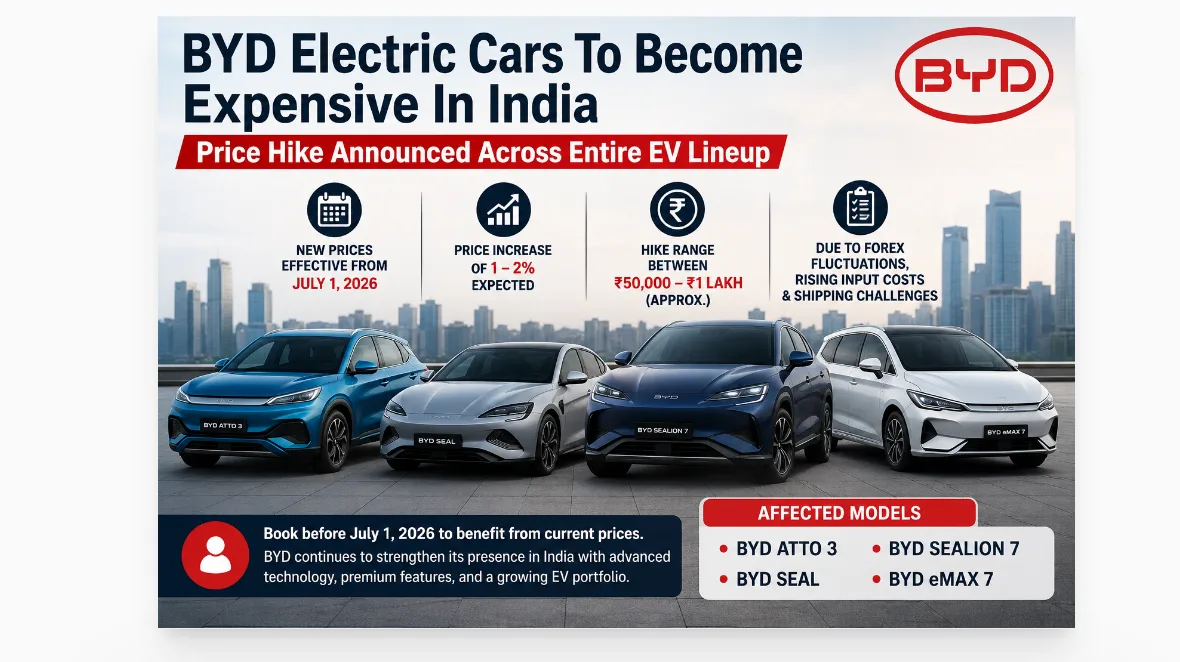
Chinese EV giant BYD has officially announced a price hike for its electric vehicles in India, citing rising operational pressures. The revised prices will officially come into effect from July 1, 2026, impacting the brand’s entire passenger EV portfolio currently on sale in the country.
Rising Costs Trigger Price Revision For BYD
The company has confirmed that the price increase is expected to be approximately 1 to 2 percent, varying by model and variant. Several global and domestic factors have contributed to this decision.
BYD pointed toward continued foreign exchange fluctuations, rising input costs, and persistent global shipping challenges as the primary reasons for the revision.
Additionally, increasing logistics expenses and ongoing supply chain disruptions have added significant financial pressure on automakers globally.
Impact on Model Lineup
The price hike will be reflected across all four models currently offered by BYD in the Indian market. Buyers can expect an approximate increase ranging between Rs 50,000 and Rs 1 lakh, depending on the specific variant.
The affected models include:
BYD Atto 3: The popular electric SUV.
BYD Seal: The premium electric sedan.
BYD Sealion 7: The recently launched performance SUV.
BYD eMAX 7: The updated electric MPV.
Opportunity for Prospective Buyers
While the price hike is imminent, there is a small window for savings. Customers who finalize their vehicle bookings before the July 1 deadline may still benefit from the current ex-showroom prices.
Despite the rising costs, BYD remains committed to its aggressive expansion in India’s premium EV segment, continuing to introduce advanced blade battery technology and premium features to attract tech-savvy buyers.
Market Outlook
This move by BYD reflects a broader trend in the Indian automotive industry. Rising global costs and forex volatility are forcing several manufacturers—including those in the EV space—to revise their pricing structures to maintain sustainability. Even as the demand for clean mobility grows, external economic factors continue to influence the final sticker price for Indian consumers.
Also Read: Looking for a Mahindra SUV? Check Out the Massive Cash Discounts This May