India To Introduce Vehicle-To-Vehicle Communication Technology To Prevent Road Accidents: How It Works
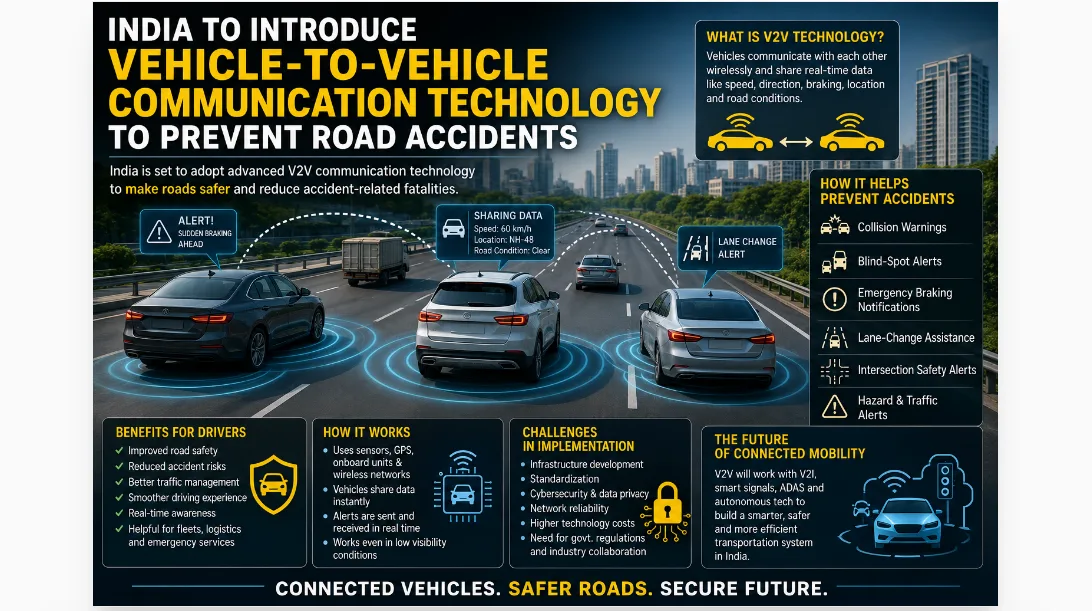
India is preparing to adopt advanced Vehicle-to-Vehicle (V2V) communication technology as part of its intense efforts to improve road safety and drastically reduce accident-related fatalities.
Historically, India records one of the highest numbers of road accidents globally, making intelligent safety technology a critical priority for both policymakers and automakers.
V2V technology allows vehicles to communicate directly with each other in real time, sharing vital data like speed, braking patterns, traffic positions, and imminent collision risks. This revolutionary system is set to become an essential pillar of India’s future connected mobility ecosystem.
What Is Vehicle-To-Vehicle Communication Technology?
Vehicle-to-Vehicle (V2V) communication is a short-range wireless network technology that enables vehicles to automatically exchange critical safety and operational data without human intervention.
Fitted with specialised onboard units, connected vehicles can continuously broadcast and receive a 360-degree flow of information.
This real-time stream includes metrics such as exact location, velocity, direction of travel, and rapid deceleration. Essentially, the technology gives vehicles an active digital awareness of their surrounding traffic situation long before the driver or traditional cameras can visually see any threat.
How V2V Technology Works?
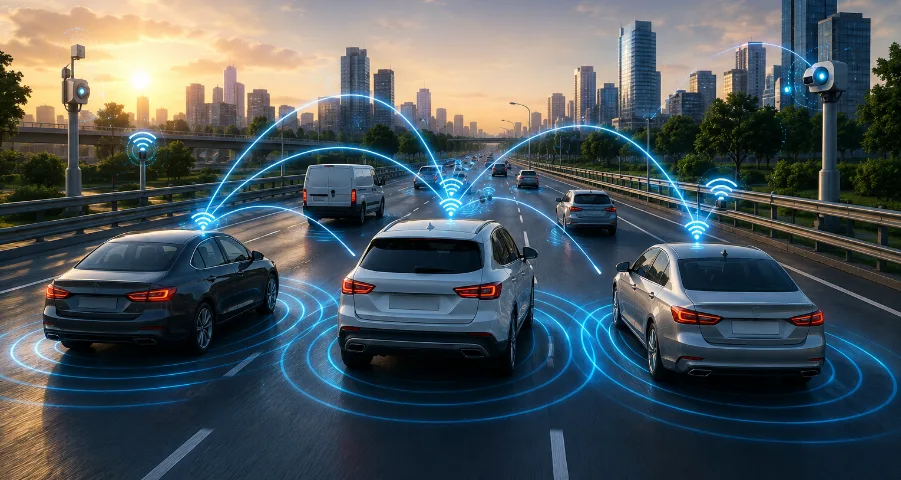
The core mechanism of V2V technology relies on built-in sensors, GPS, and dedicated radio frequency modules working over wireless networks.
The Indian government’s Department of Telecommunications has cleared a dedicated 30 MHz spectrum band (around 5.9 GHz) specifically for this.
Operating like highly rapid, automated walkie-talkies, vehicles transmit basic safety messages up to ten times per second. If a leading car aggressively slams its brakes or hits a sudden hazard, it instantly beams a warning to all trailing vehicles within a 300-metre radius.
This system works perfectly across poor visibility conditions such as dense winter fog, heavy monsoon downpours, blind highway turns, and dark night driving.
How It Can Help Prevent Road Accidents?
On-road implementation of V2V systems provides a massive safety net by activating proactive alerts like forward collision warnings, blind-spot assistance, emergency brake indicators, and intersection cross-traffic alerts.
By getting data straight from the source rather than waiting for an visual reaction, driver response times are cut significantly, helping prevent disastrous multi-car pileups.
This technology will be a total game-changer on major fast-moving Indian corridors like the Yamuna Expressway or the Delhi-Mumbai Expressway, where high-speed rear-end crashes and blind-spot collisions are unfortunately frequent.
Benefits For Indian Drivers And Road Users
For everyday Indian motorists, the introduction of V2V safety tech offers a smoother, far more predictable driving environment.
Beyond slashing collision risks, the constant web of vehicle data permits smarter traffic management, which can ease heavy city gridlocks by preventing unnecessary bottleneck stops.
Commercial fleet owners, public bus operators, and emergency services like ambulances will benefit heavily, too.
Ambulances can broadcast their real-time arrival to cars ahead, clearing up an active path seamlessly and saving crucial response time during golden hour emergencies.
Challenges In Implementation
Deploying this technology nationwide presents a few notable hurdles. Achieving true interoperability means all car manufacturers must agree on uniform communication standards.
Moreover, there are valid concerns around data privacy, wireless encryption security against hacking, and the initial hardware cost of installing these onboard units, estimated between ₹5,000 and ₹7,000 per car.
Because V2V relies on a shared network effect to be effective, the real challenge will be scaling up the technology so that a large enough percentage of cars on Indian roads can actually “talk” to one another.
Also Read: Maruti E100 Flex Fuel To Launch In India On June 5: Everything We Know So Far
Future Of Connected Mobility In India
Looking forward, standalone V2V communication is simply step one. It will eventually scale into a broader Vehicle-to-Everything (V2X) ecosystem, where cars seamlessly chat with smart traffic signals, pedestrian smartphones, and highway toll plazas (Vehicle-to-Infrastructure).
This connected framework will work hand-in-hand with existing Advanced Driver Assistance Systems (ADAS), serving as the foundational building block for semi-autonomous and fully automated driving solutions in India down the line.
Also Read: 2026 Tata Tiago Vs Maruti Suzuki Swift: Which Hatchback Is The Better Option For You?