
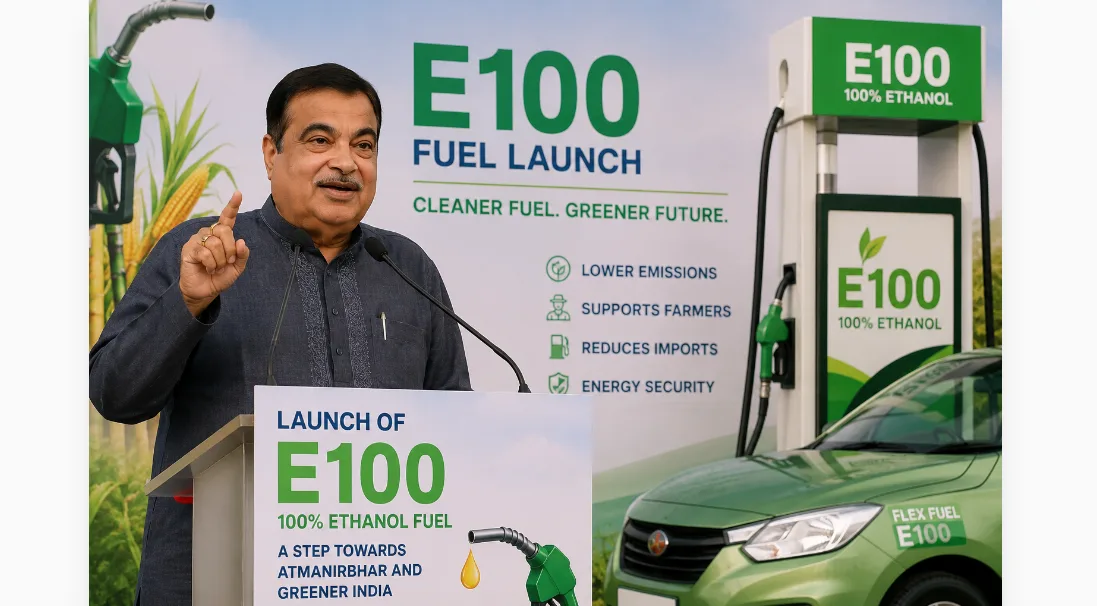
“People Used To Laugh At My Dream”: Nitin Gadkari Launches E100 Fuel, Says India’s Ethanol Revolution Is Now A Reality
Union Minister for Road Transport and Highways Nitin Gadkari has officially signed and approved the long-awaited regulations granting full legal recognition to 100% ethanol (E100) as an automotive fuel.
Speaking at a press conference in Nagpur, Gadkari reflected on India’s historic journey toward ethanol-based green mobility. He recalled how, years ago, many skeptics and critics openly laughed when he envisioned running mainstream vehicles entirely on plant-based alternatives.
Today, that persistence has translated into the successful nationwide rollout of E20 blended petrol, public showcases of flex-fuel vehicles, and now the regulatory clearance for E100.
This milestone marks a massive stride in the government’s comprehensive strategy to slash crude oil imports, reduce heavy fiscal burdens, support local farming communities, and drastically curb hazardous vehicular emissions across the transportation ecosystem.
What Did Nitin Gadkari Say?
Addressing the media gathering, Nitin Gadkari shared the exact moment his vision became a legal framework.
“Last night at 8 PM, I signed the file, finalising the regulations to legally authorise the use of 100% ethanol. People used to laugh when I spoke of this dream, and some friends even used to criticise it,” Gadkari stated.
The minister revealed that early attempts were frequently made to spread misinformation to defame biofuels. He shared a lighthearted anecdote about a public personality who complained that his vehicle had broken down due to ethanol blending, only for Gadkari to point out that the vehicle ran on diesel, which does not contain ethanol at all.
Ultimately, the government remained undeterred by skepticism, consistently pushing for local alternative fuels to reduce the nation’s massive dependence on imported fossil fuels.
What Is E100 Fuel?
E100 fuel represents 100% pure ethanol, utilized as a direct, standalone alternative to conventional petrol. Unlike the current retail standard of E20 fuel—which blends 20% ethanol with 80% fossil petrol—E100 completely eliminates crude oil from the combustion equation.
Ethanol is an alcohol-based biofuel produced domestically through the fermentation of food crops and organic matter, including:
Sugarcane juice, molasses, and sugar beet
Damaged food grains, broken rice, and maize (corn)
Agricultural residues, biomass, and plant-based waste
Because pure ethanol possesses different chemical combustion properties and higher corrosiveness than ordinary petrol, standard internal combustion engines cannot safely digest it.
Consequently, vehicles must be equipped with specialized flex-fuel engines that feature modified fuel injectors, hardened valves, and calibrated engine control units (ECUs) to dynamically alter fuel-to-air ratios.
How Can E100 Benefit India?
The nationwide adoption of E100 offers profound economic and environmental rewards for India. Chiefly, it addresses energy security by targeted reduction in the country’s staggering Rs 22 lakh crore ($250 billion) annual crude oil import bill. By shifting the energy demand toward locally produced resources, India retains massive fiscal capital within its domestic economy.
For the agricultural sector, the biofuel mandate creates a highly reliable, parallel stream of income for farmers, transforming crop surpluses and agricultural waste into high-value cash products. From an environmental standpoint, pure ethanol burns significantly cleaner than fossil fuels. It cuts tailpipe carbon monoxide, aromatic hydrocarbons, and greenhouse gas emissions, directly supporting the government’s strict net-zero goals and improving air quality indexes in congested urban hubs.
Which Vehicles Can Run On E100 Fuel?
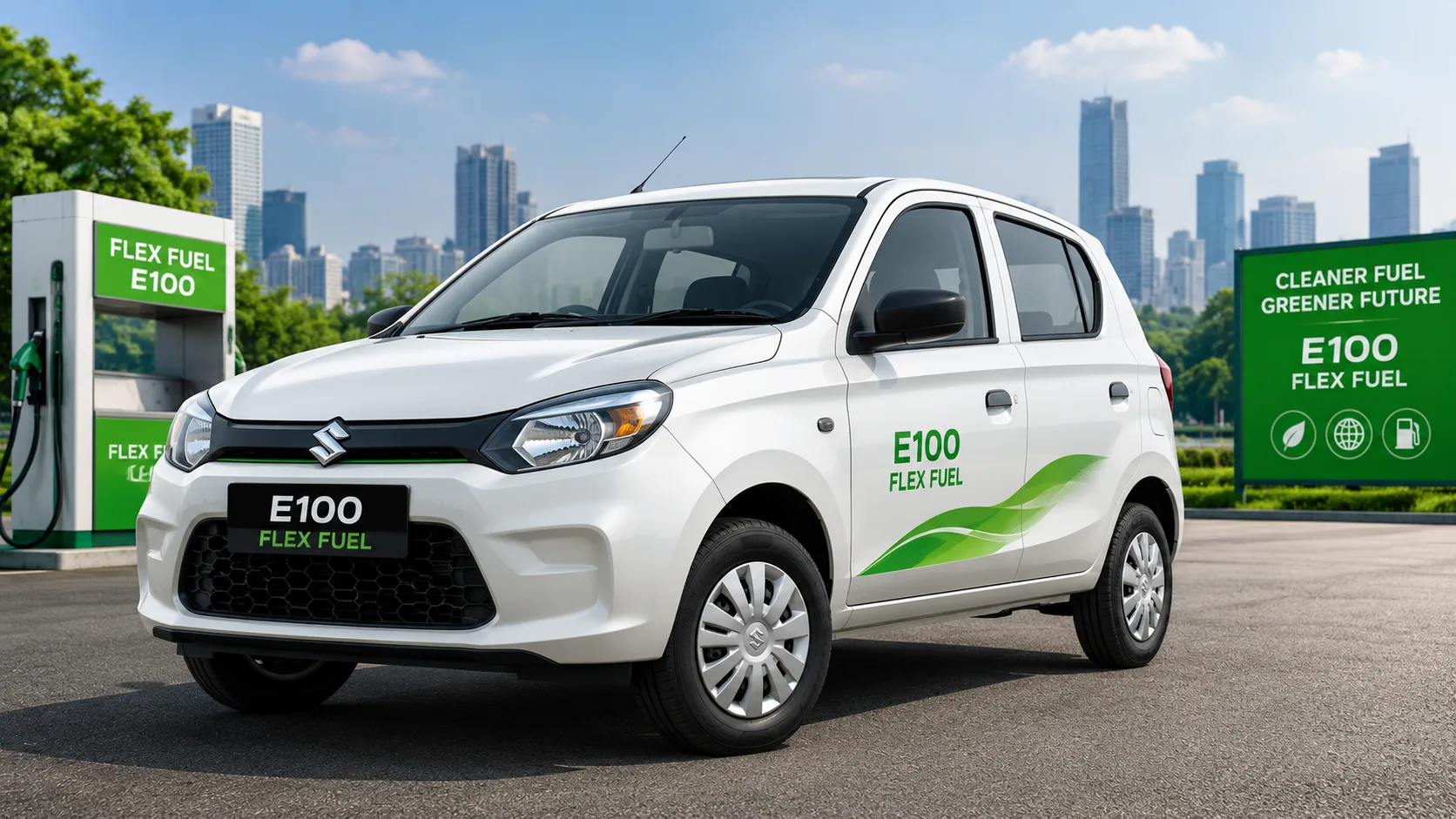
Vehicles must be specifically built or converted into Flex-Fuel Vehicles (FFVs) to run safely on E100. Fortunately, major manufacturers are responding aggressively to the government’s policy push.
Gadkari highlighted that he, alongside Petroleum Minister Hardeep Singh Puri, recently unveiled a 100% ethanol-compatible prototype of the Maruti Suzuki WagonR—one of India’s highest-selling hatchbacks.
In the two-wheeler space, Hero MotoCorp has already successfully launched E85-compatible flex-fuel variants of the highly popular Splendor+ and HF Deluxe motorcycles.
Gadkari announced that multiple automotive heavyweights—including Toyota, Suzuki, Hyundai, and MG Motor—are currently preparing a wave of production-ready, 100% ethanol-compatible cars and SUVs slated to break cover within the next month and a half.
Challenges Facing E100 Adoption
Despite robust legislative support, transitioning to a nationwide E100 ecosystem will take significant time due to several key roadblocks:
Infrastructure Constraints: Standard fuel pumps cannot dispense pure ethanol; oil marketing companies must invest heavily in dedicated E100 underground storage tanks and corrosion-resistant dispensing nozzles.
Production Scaling: Generating billions of liters of pure ethanol requires massive expansion of distillation plants without disrupting national food security.
Taxation Hurdles: Fuels with ethanol blends exceeding 20% currently face a high 18% GST rate, though Gadkari has actively engaged with the Finance Ministry to seek a reduction from the GST Council.
Consumer Awareness: Dispelling legacy myths surrounding engine damage and fuel efficiency drops remains crucial to building public trust.
What Does This Mean For India’s Automotive Future?
The formal legalization of E100 signifies that the Indian government is refusing to rely on a single-technology path for sustainable transit. Instead, policymakers are cultivating a diverse multi-fuel strategy where ethanol, battery electric vehicles (EVs), compressed natural gas (CNG), and biofuels run parallel.
To prove this multi-pronged approach, Gadkari also announced an upcoming pilot project in Nagpur featuring a green hydrogen refueling station and two hydrogen-powered public buses, demonstrating that the future of Indian motoring will be distinctly multi-faceted and eco-conscious.
Also Read: Ducati Desmo450 EDS Revealed: First-Ever Street-Legal Enduro Bike From Ducati
Conclusion
The regulatory approval of E100 fuel stands as a triumphant turning point in India’s quest for sustainable, self-reliant transportation. Nitin Gadkari’s candid reflections prove how a once-ridiculed concept can transform into mainstream reality through aggressive policy implementation and manufacturing alignment.
While infrastructure bottlenecks and taxation challenges require resolution, E100 is uniquely positioned to deliver long-term environmental protection, enhanced rural prosperity, and robust energy independence for the nation in the coming years.
Also Read: BMW Concept M Neue Klasse Unveiled: Is This the Future Electric M3?