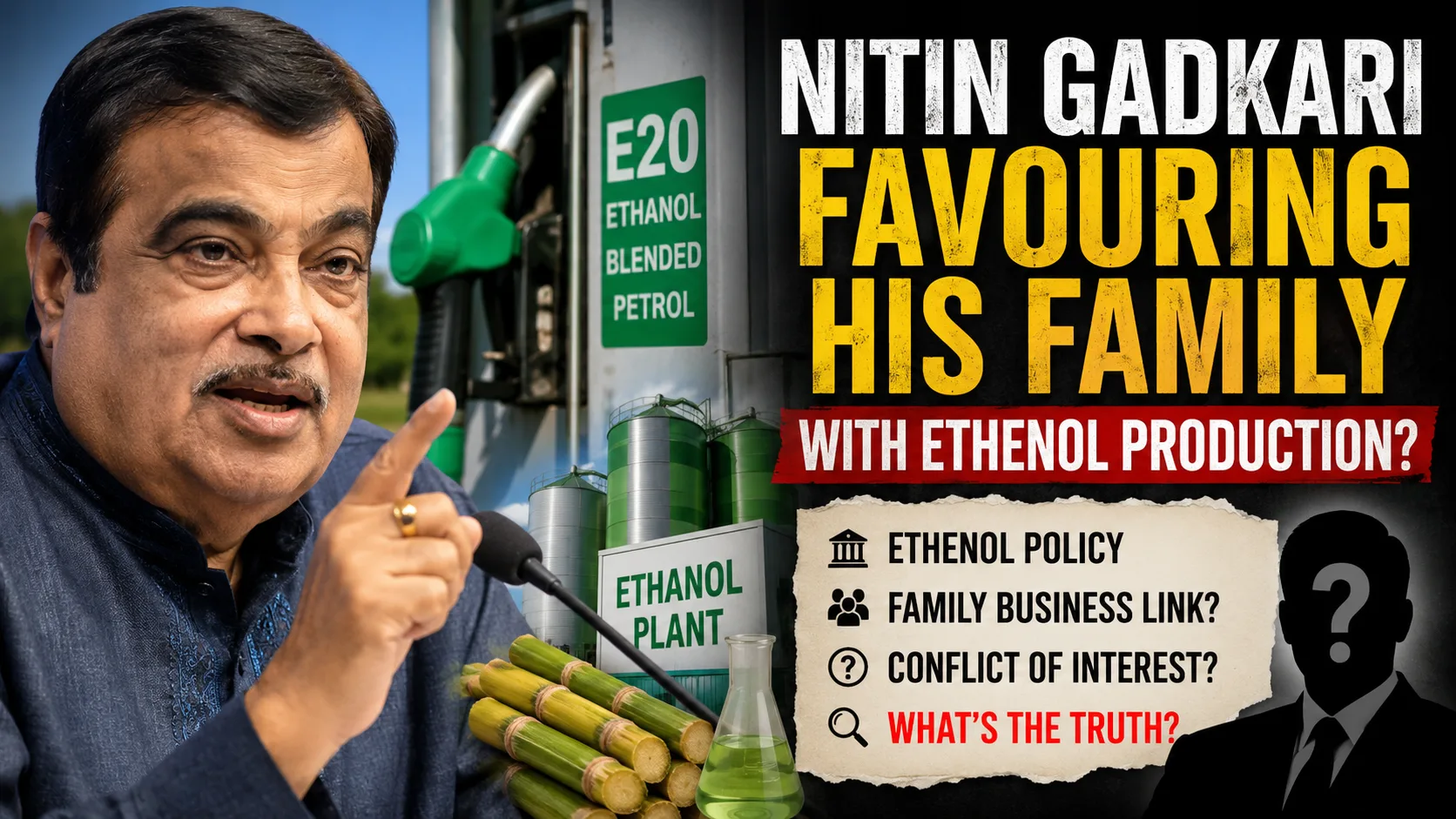
Helping Farmers or Helping Sons? Why Nitin Gadkari’s Fuel Plan Faces Tough Questions
India is trying hard to switch to clean, green fuel. But a big argument has started about whether the government’s rules are fair.
At the center of this fight is government minister Nitin Gadkari. He is the main leader pushing the country to use ethanol (a green fuel made from plants). Now, he has to defend himself because people are saying he gave special favors to his friends and family.
Critics are asking a tough question: Was this new fuel rule really made to help poor farmers and save the country money? Or was it secretly created to help companies owned by the minister’s own family make a lot of money?
Why the allegation is being discussed?
The big debate started because the main opposition party, the Congress party, held a press conference and made serious statements against Nitin Gadkari. They pointed out that his two sons own and run big ethanol companies.
The opposition showed financial reports claiming that these family companies suddenly made massive amounts of money with one company’s revenue jumping from 18 crore rupees to over 500 crore rupees, right after the government pushed the new ethanol rules.
The discussion became even bigger after Nitin Gadkari gave interviews on television (like India Today TV) to defend himself. He called the attacks a political conspiracy to ruin his name.
He said his family had their business long before the government rules were made, and that they only make a tiny fraction (less than 1%) of the country’s total ethanol, so he is not using his power to make them rich.
Nitin Gadkari’s role in ethanol policy?
For more than twenty years, Union Minister Nitin Gadkari has been the biggest supporter of alternative fuels in India. Long before it became a major government policy, he was urging the country to stop relying only on petrol and diesel and start using biofuels like ethanol, which is made from plants like sugarcane and corn.
To make this happen nationwide, the government created the E20 roadmap. The goal of this plan is to mix 20% ethanol into all petrol across India.
The plan has four main targets:
Save Money on Oil: India spends massive amounts of money every year to buy crude oil from other countries. Mixing in ethanol means India buys less foreign oil and keeps its money at home.
Help Sugarcane Farmers: Ethanol is made from the leftover juice of crops like sugarcane. This gives farmers a brand-new way to sell their crops, increases their income, and ensures they get paid on time.
Lower Pollution: Ethanol burns much cleaner than regular petrol. By using it, the government aims to cut down harmful smoke and greenhouse gases to clean up the air in crowded cities.
Secure India’s Energy: By making its own fuel from local crops, India does not have to worry as much about global wars or foreign supply chains stopping its fuel flow.
Business interests
Reports show that Nitin Gadkari’s family has been in the sugar and biofuel business for a long time. His son, Nikhil Gadkari, owns more than 60% of the shares in a major biofuel company called CIAN Agro Industries.
Records show that this company’s revenue grew incredibly fast from 17 crore rupees to 1,200 crore rupees around the same time the government started pushing the new ethanol rules.
However, it is important to separate two things:
Family Ownership: The minister’s family owns and invests in these factories, and they make money selling ethanol.
Government Rules: The rules to mix ethanol into petrol are made by the whole government cabinet and the Ministry of Petroleum, not just by Nitin Gadkari alone.
There is no official proof from a court showing that the minister changed the law just to make his family rich.
Also Read: This Yamaha Bike Can Run on E20 to E85 Fuel, Launched at Rs 1.24 Lakh
The Minister’s Response
Nitin Gadkari has strongly denied all the allegations. In major television interviews, he explained that his family started their sugar business long before the government even created the new ethanol rules.
He stated that India has about 550 factories making ethanol, and his family’s business produces only a tiny fraction just 0.07%—of the country’s total fuel.
He argues that with such a tiny share, it makes no sense to say he changed national laws just to benefit himself. He called the attacks a political plan by the opposition to hurt his name.
Also Read: Tata Sierra Jubilee Edition Revealed: Gets New Features, and Premium Accessories
Experts Say
Experts have different views on India’s big push for ethanol:
Energy and Industry Experts: Many agree that making fuel locally helps India become independent and saves the country from spending too much money on foreign oil.
Environmental and Farming Experts: Some experts worry about the hidden costs. They point out that crops like sugarcane and rice need massive amounts of water. They worry that using groundwater to grow crops for fuel could cause water shortages and hurt food supplies in the future.
Reviewing the Facts
To understand the truth, observers look at three main facts:
The Process: The ethanol laws went through the normal, official government Cabinet approval process, involving multiple ministries.
The Winners: The policy applies to the entire country, meaning hundreds of different sugar mills and ethanol factories across India are benefiting, not just one company.
The Evidence: While financial records clearly show the Gadkari family company grew very rapidly, there is no official document proving they received special rule changes that other companies did not get.
Also Read: Kia Syros EV All Details Leaked: Unofficial Booking Opens