
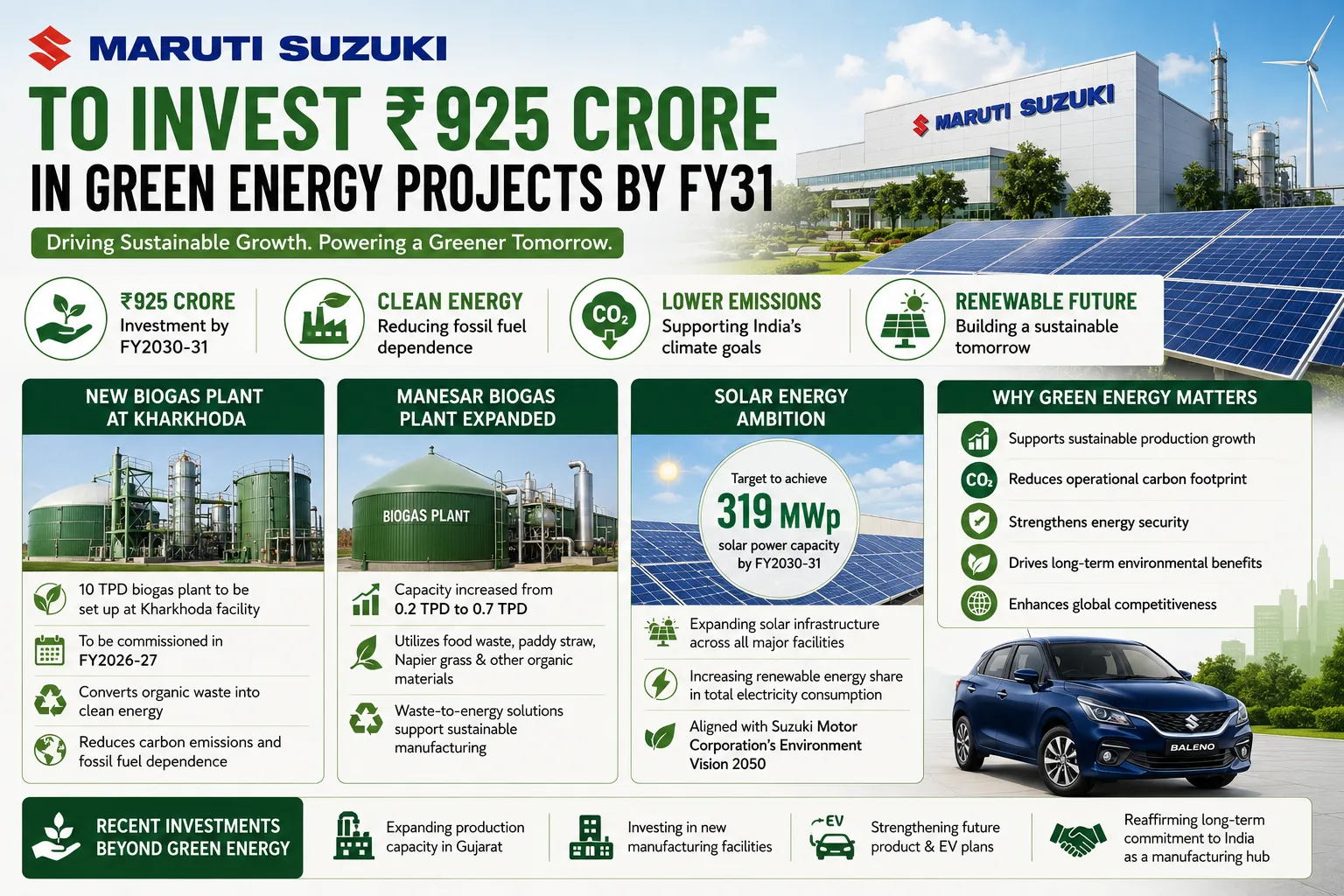
Maruti Suzuki to Invest Rs 925 Crore in Green Energy Projects by FY31
Sustainability has shifted from being a corporate buzzword to becoming a core strategic pillar for automobile manufacturers worldwide.
As India rapidly moves toward cleaner mobility solutions and aggressively works to reduce its dependence on volatile fossil fuels, automakers are recognizing that clean tailpipes are only half the battle.
To truly achieve carbon neutrality, investing heavily in renewable energy and green manufacturing practices across factory floors has become a necessity.
In a decisive move toward sustainable industrial growth, India’s largest carmaker, Maruti Suzuki India Limited, has officially announced a massive investment of Rs 925 crore earmarked entirely for green energy initiatives by FY2030-31.

Maruti Suzuki Announces Rs 925 Crore Green Energy Investment
Maruti Suzuki plans to systematically deploy this Rs 925 crore investment over the next few years, building a robust internal ecosystem of renewable energy and long-term sustainability projects. This financial roadmap forms a critical branch of the automaker’s environmental strategy, directly aimed at lowering the carbon footprint generated during vehicle assembly.
By curbing conventional electricity usage and substituting it with green power, Maruti Suzuki intends to heavily reduce its fossil fuel consumption while simultaneously supporting India’s energy security and emission reduction targets.
Commenting on the eco-conscious transition, Hisashi Takeuchi, Managing Director & CEO of Maruti Suzuki India Limited, stated that the company is consistently scaling up initiatives to drop fossil fuel dependence.
He emphasized that in a global climate navigating an increasingly uncertain energy landscape, such investments assume much greater operational and national significance.
New Biogas Plant Planned at Kharkhoda Facility
A cornerstone of the brand’s immediate green roadmap is the establishment of a large-scale, 10 Tonnes Per Day (TPD) biogas plant at its upcoming mega manufacturing facility in Kharkhoda, Haryana.
Commissioning Timeline: The advanced biogas unit is firmly on track for commissioning within the FY2026-27 window.
Waste-to-Energy Mechanism: The facility is engineered to convert organic waste matrices into highly efficient, clean biogas via anaerobic digestion.
Carbon Mitigation: At peak operational capability, the plant is mathematically projected to mitigate a striking 9,490 tonnes of CO2 emissions annually.
Energy Output: The generated clean gas will supply nearly 20% of the entire Kharkhoda facility’s internal gas heating requirement, powering critical operations like the paint-shop ovens and employee canteens.
Manesar Biogas Plant Capacity Expanded
In tandem with the massive project at Kharkhoda, Maruti Suzuki has successfully executed a major capacity expansion at its pre-existing biogas setup within the Manesar manufacturing ecosystem.
The facility’s processing potential has been more than tripled, scaling directly from a minor 0.2 TPD output up to a far more impactful 0.7 TPD.
This upgraded site acts as a model circular-economy blueprint, effectively utilizing local raw materials such as factory food waste, paddy straw, and Napier grass.
By processing this biomass efficiently, the Manesar upgrade generates an estimated 360,000 standard cubic meters of clean gas annually, preventing roughly 664 tonnes of CO2 from escaping into the atmosphere each year. This step highlights the immense value of integrated waste-to-energy solutions in contemporary, heavy-scale automotive production.
How Renewable Energy Supports Maruti Suzuki’s Growth Plans
Maruti Suzuki is currently pursuing an aggressive growth model, targeting a massive ramp-up in localized vehicle production capacity to cross 4 million units annually by the end of the decade.
However, stepping up production output linearly without checking energy sources would inevitably cause an operational carbon footprint surge.
To prevent this, the automaker is matching its capacity expansion with clean energy infrastructure. Expanding alternative power setups across all localized assembly networks allows the brand to separate industrial output growth from environmental degradation.
In the modern global trade landscape, building an auditable, green supply chain acts as an immense competitive advantage, making the manufacturer more resilient against incoming eco-tariffs and carbon taxes.
Maruti Suzuki’s Solar Energy Ambitions
Beyond its rapid strides in bio-energy solutions, Maruti Suzuki is implementing a highly ambitious, long-term solar power expansion model.
The carmaker has set a firm target to achieve a massive 319 MWp (Megawatt peak) of total solar power capacity across its manufacturing facilities by FY2030-31.
Following recent infrastructure upgrades—which added a 20 MWp array at Kharkhoda and a 10 MWp expansion at Manesar—the company’s immediate solar baseline sits at a solid 79 MWp.
By scaling this layout nearly four times over by the turn of the decade, Maruti Suzuki will significantly increase the ratio of clean electricity feeding its heavy assembly equipment.
This aligns closely with parent company Suzuki Motor Corporation’s international Environment Vision 2050 framework, as well as the Indian Government’s goal of reaching 500 GW of non-fossil fuel energy capacity.
Why Green Manufacturing Matters for the Indian Auto Industry
The regulatory environment surrounding India’s automotive sector is tightening at an unprecedented pace. With the government locking in clear milestones for net-zero timelines, automotive corporations are facing immense pressure to clean up both their vehicles and their manufacturing facilities.
Furthermore, industrial energy security remains highly vulnerable to shifting international fuel markets. Incorporating grid-independent solar farms and localized biogas generation provides automakers with an effective barrier against sudden fuel price shocks.
As the market leader, Maruti Suzuki’s aggressive investment strategy serves as an influential industry case study, likely prompting rival original equipment manufacturers (OEMs) to accelerate their own factory-level green energy transitions.
Also Read: Gucci Enters Formula 1 Sponsorship: Why Luxury Fashion Brands Are Racing Into Motorsports
Maruti Suzuki’s Recent Investments Beyond Green Energy
The green transition moves in perfect lockstep with Maruti Suzuki’s aggressive industrial scaling across India. The automotive giant has consistently reinforced its multi-billion-rupee commitment to keeping India as its primary global manufacturing hub through several major moves:
Gujarat Expansion: Massive financial investments channeled to construct a brand-new, high-capacity production line at the Suzuki Motor Gujarat (SMG) site.
New Manufacturing Plants: Setting up the immense Kharkhoda complex from the ground up, designed to serve as a tech-forward production center.
Future EV Roadmap: Allocation of immense R&D funds geared toward localizing battery pack manufacturing and preparing assembly lines for upcoming global electric vehicle (EV) architectures.
The Times of Gen-Z Verdict
Maruti Suzuki’s Rs 925 crore investment plan represents a major turning point for the Indian auto industry. This initiative demonstrates that true environmental responsibility requires looking beyond zero-emission tailpipes and actively decarbonizing the heavy factories that construct the vehicles.
By combining massive rooftop solar setups with circular, waste-to-wealth biogas networks, Maruti Suzuki is systematically protecting its sprawling manufacturing operations against future energy shocks and stringent carbon regulations.
While the transition to full passenger vehicle electrification will take time, ensuring that the vehicles rolling off the assembly lines today are built using clean, renewable energy gives Maruti Suzuki a massive advantage, positioning them as a genuine leader in sustainable manufacturing.
Also Read: Tata Motors May 2026 Sales Report: 42% Growth Helps Tata Retain No.2 Position In India