
Next-Gen Toyota Hilux Spotted During TV Commercial Shoot In New Delhi: Major Design And Technology Upgrades Expected
The next-generation Toyota Hilux has been spotted in India for the first time, caught completely undisguised during a television commercial (TVC) shoot in New Delhi’s Aerocity.
The sighting has ignited massive excitement among pickup truck enthusiasts, as the “Sunglow” colored test vehicle offered a clear, camouflage-free look at the substantial revisions Toyota is bringing to its legendary lifestyle vehicle.
Globally recognized for its indestructible “Quality, Durability, and Reliability” (QDR), the Hilux has long been the benchmark for rugged off-road capability.
This latest appearance suggests that Toyota is shifting gears to move beyond the commercial segment, preparing a more premium, tech-loaded version of the pickup to capture the growing “lifestyle” audience in India.
The new model is expected to debut with major upgrades in design, cabin comfort, and safety tech.
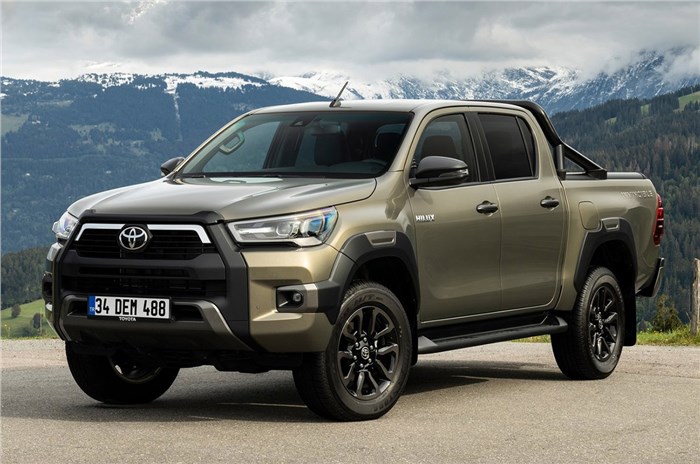
Next-Gen Toyota Hilux Seen During Ad Shoot
Spotted recently during a professional film shoot in the national capital, the undisguised pickup appeared production-ready. Seeing a vehicle during a TV commercial shoot is a classic industry indicator that the official reveal and market launch are imminent. Unlike previous test mules seen under heavy wrapping, this sighting revealed the final exterior styling, finished in a striking new copper-gold shade.
The move highlights Toyota’s intent to position the new Hilux as more than just a workhorse. As the Indian market shows increasing interest in premium lifestyle pickup trucks for adventure and overland travel, Toyota seems to be fast-tracking the ninth-generation model to maintain its dominance in the niche segment.
Bold New Exterior Design Expected
The upcoming Hilux adopts a much sharper and more aggressive “Tough x Agile” design language. The most prominent change is the front fascia, which features a massive trapezoidal grille with a gloss-black mesh pattern and prominent “TOYOTA” lettering instead of the standard logo.
Sleeker LED Lighting: Slimmer horizontal LED headlamps with integrated DRLs give it a modern, tech-forward face.
Muscular Stance: Redesigned bumpers house vertical fog lamp housings and a brushed aluminum-style skid plate for better approach angles.
Fresh Details: The side profile reveals newly designed 17-inch or 18-inch black alloy wheels and chunky flared wheel arches.
Rear Upgrades: At the back, expect new L-shaped LED tail lamps and an integrated step in the rear deck for easier access to the cargo bed.
Premium Cabin And New Technology
While the Hilux is traditionally utilitarian, the next-gen interior receives a massive overhaul inspired by the latest Land Cruiser 250 series. The dashboard moves away from basic plastics toward a more layered, upscale design with higher-quality materials.
The centerpiece of the new cabin is a 12.3-inch floating touchscreen infotainment system supporting wireless Android Auto and Apple CarPlay.
Drivers will also likely benefit from a new 12.3-inch fully digital instrument cluster and a modern steering wheel with integrated ADAS controls.
To boost its “lifestyle” appeal, the new Hilux is expected to include ventilated front seats, dual-zone automatic climate control, a wireless phone charger, and a powered rear window that opens into the loading bay—a feature previously seen on global models.
Powertrain And Off-Road Capability
Toyota will likely stick with its bulletproof 2.8-litre four-cylinder turbo-diesel engine, but with a modern twist. Reports suggest the India-spec model will receive a 48V mild-hybrid system (Neo Drive), similar to the upcoming Fortuner.
| Component | Specification |
| Engine | 2.8L Turbo Diesel + 48V Mild Hybrid |
| Power/Torque | 204 PS / Up to 500 Nm |
| Transmission | 6-speed MT / 6-speed AT |
| Efficiency | ~10% improvement expected |
The off-road hardware is set to become even more capable with an upgraded Multi-Terrain Select system, electronic differential locks, and a 360-degree camera with an “under-body” view for technical trails.
A major mechanical upgrade is the introduction of Electric Power Steering (EPS), which will make the truck easier to maneuver in city traffic compared to the heavy hydraulic setup of the current model.
Safety Features Likely To Be Upgraded
Safety is a major pillar of this generational shift. The next-gen Hilux has already secured a five-star ANCAP crash test rating globally and is expected to bring Toyota Safety Sense (ADAS) to the Indian market. Key safety additions will likely include:
Adaptive Cruise Control and Lane Departure Warning.
Automatic Emergency Braking and Blind Spot Monitoring.
Seven airbags as standard.
Front and rear parking sensors with a 360-degree monitor.
Expected Launch Timeline And Price
Though Toyota India has not officially confirmed the date, the TVC shoot in Delhi suggests a launch could happen by late 2026 or early 2027. Positioning as a premium lifestyle pickup, the next-gen Toyota Hilux is expected to see a price hike, with an ex-showroom range between Rs 32 lakh and Rs 45 lakh, depending on the variant and mild-hybrid options.
Rivals Of The Next-Gen Toyota Hilux
The premium pickup segment in India remains niche but is expanding. The Hilux will primarily compete with the Isuzu V-Cross, which currently stands as its only direct rival.
However, it also competes for buyers considering premium off-road SUVs like the Jeep Compass, Hyundai Tucson, or even its own sibling, the Toyota Fortuner. As more adventure-seekers look for versatile utility vehicles, the Hilux stands alone in offering both extreme ruggedness and a massive 700 kg+ payload capacity.
Also Read: 2027 Kia Sonet: What Can We Expect From Kia’s Best-Selling Compact SUV?