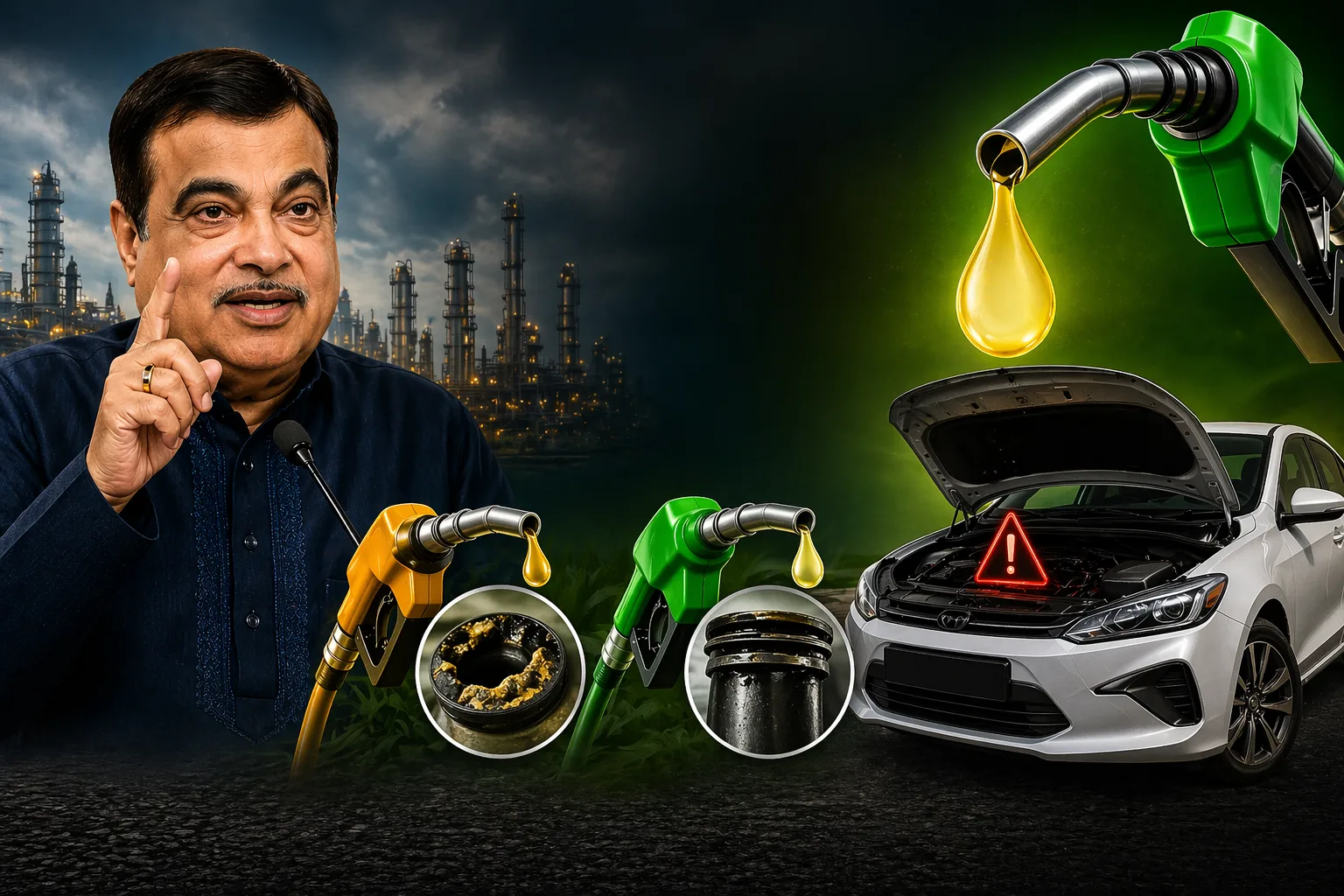
Nitin Gadkari’s E100 Vision: Will Your Petrol Car Survive the Ethanol Revolution?
The Indian automotive landscape is shifting faster than a DSG gearbox. Just as we were getting used to the “E20 Ready” stickers on our new car windshields, Union Minister Nitin Gadkari has dropped a bombshell: the push for E100 fuel India.
For the uninitiated, E100 isn’t just a minor upgrade; it is 100% pure ethanol. While the government paints a picture of a greener, “Aatmanirbhar” India, the average car owner is left with a sinking feeling in their gut.
Is your current petrol car destined for the scrapyard? Will your mileage tank faster than a lead balloon? As an expert in the Indian auto space, I’m stripping away the policy jargon to tell you exactly how the ethanol revolution will hit your garage and your wallet.
Also Read: BS7 Emission Norms in India: Stricter Rules for Cars and Bikes from 2027
Nitin Gadkari’s 100% Ethanol Blending Vision Explained
Minister Nitin Gadkari is often called the “Ethanol Man” of India, and for good reason. His roadmap is aggressive, aiming to decouple India’s economy from the volatile global crude oil market.
By pushing for E100, the government aims to save billions in foreign exchange. But it’s not just about the money. This is a massive play for the agrarian economy. By converting surplus sugarcane and food grains into fuel, the government wants to turn “Annadatas” (farmers) into “Urjadatas” (energy providers).
The vision includes a nationwide network of E100 pumps and a mandate for manufacturers to produce Flex-Fuel Vehicles (FFVs). Brands like Toyota and Tata have already showcased prototypes, but the transition from a “pilot project” to your local fuel station is a mountain yet to be climbed.
What Exactly is E100 Fuel?
Simply put, E100 is neat ethanol. Unlike the petrol you currently pump, which is a fossil fuel, ethanol is an alcohol produced by fermenting plant sugars.
There are three technical realities you need to know:
Octane Rating: E100 has a very high octane rating (around 110), meaning it can handle high compression without “knocking.”
Energy Density: This is the catch. Ethanol has about 33% less energy density than petrol.
Corrosiveness: Alcohol is a solvent. It loves to eat through certain rubbers and plastics that have lived happily with petrol for decades.
E20 vs E100 Impact: The Quiet Damage Already Happening
We are currently in the middle of the E20 rollout. While manufacturers claim their new BS6 Phase 2 cars are “E20 compliant,” owners of older vehicles are already feeling the pinch.
Real-World Issues with E20:
The Mileage Dip: Ask any Maruti Alto or Hero Splendor owner who’s been using E20. Most report a 5–10% drop in fuel efficiency.
Rough Idling: Older engines, not tuned for the oxygen-heavy ethanol mix, often suffer from “lean fueling,” leading to a rougher engine note and occasional stalling.
The Rubber Rot: We’ve seen cases of fuel lines in 10-year-old bikes becoming brittle and cracking. Ethanol is a magnet for moisture, leading to water buildup in the tank—a death sentence for fuel injectors.
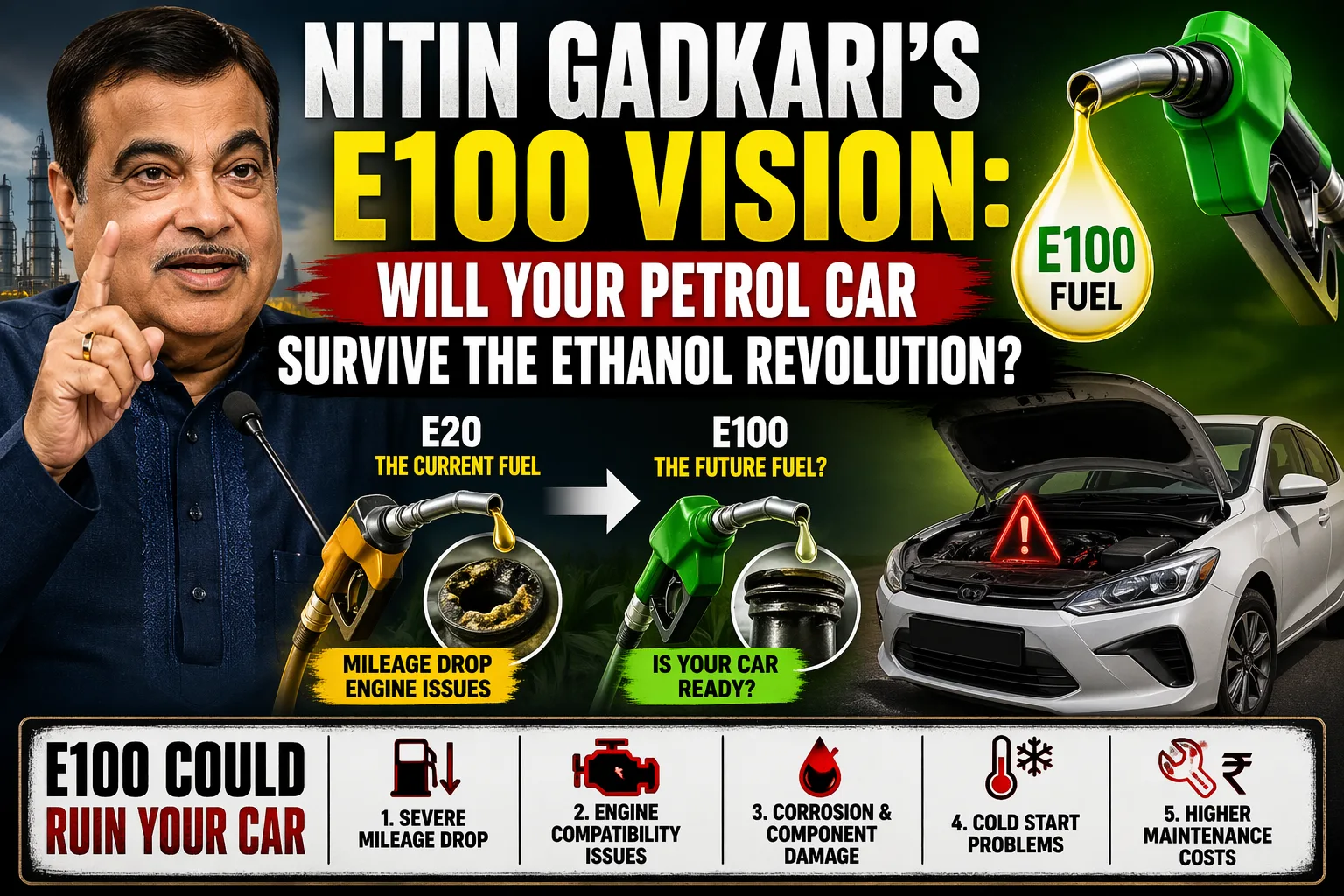
How E100 Could Ruin Your Car: 5 Major Risks
If E20 is a headache, E100 is a full-blown migraine for a standard internal combustion engine. Here is why you cannot simply “fill and forget.”
1. Severe Mileage Drop
Because ethanol has lower energy density, your engine needs to burn more fuel to produce the same power. With E100, expect your mileage to plummet by nearly 30%. If your car gives 15 km/l on petrol, it might struggle to hit 10 km/l on E100.
2. Engine Compatibility Issues
Standard engines are calibrated for a specific air-fuel ratio. E100 requires a completely different “map.” Without a specialized ECU (Engine Control Unit) and larger fuel injectors, a standard car running on E100 will simply refuse to run or will suffer catastrophic “lean burn” damage.
3. Corrosion & Component Damage
Ethanol is hygroscopic—it pulls water out of the air. This water-ethanol mix is highly corrosive. It attacks the aluminum in your engine head, the rubber seals in your fuel pump, and the lining of your fuel tank. Without “ethanol-proofed” internals, your fuel system will eventually dissolve from the inside out.
4. Cold Start Problems
Alcohol doesn’t vaporize as easily as petrol in cold weather. If you live in North India during January, starting an E100 car will be a test of patience. Most Flex-Fuel vehicles actually need a tiny “start-up” tank of pure petrol just to get the engine firing on cold mornings.
5. Higher Maintenance Costs
With E100, oil change intervals may need to be shorter. Ethanol combustion can lead to “fuel dilution” in the engine oil, stripping away its lubricating properties. You’ll be visiting the service center more often, adding to the total cost of ownership.
Are Indian Cars Ready for E100?
The short answer? No. The long answer is that your current car—even if bought in 2024—is likely only E20 compliant. To run E100, we need Flex-Fuel Vehicles (FFVs).
Indian automakers are hesitant. Developing FFVs involves costs. Upgrading fuel pumps, injectors, and engine valves isn’t cheap. Furthermore, the Indian consumer is extremely mileage-conscious. Selling a car that gives 30% less mileage is a tough marketing challenge, even if the fuel itself is cheaper.
Also Read: Top 5 Electric Scooters Under Rs 1 Lakh in India (April 2026): Best Budget EV Picks
Expert Insight: A Balanced View
We must acknowledge the ethanol fuel disadvantages, but we can’t ignore the pros. Ethanol is a high-performance fuel (high octane) and it’s significantly cleaner for the environment. It reduces carbon monoxide and particulate matter emissions drastically.
However, the “Food vs. Fuel” debate is real. Using massive amounts of water to grow sugarcane just to fuel cars in a water-stressed nation like India is a point of contention among environmentalists.
Conclusion: Should You Be Worried?
If you are planning to keep your current petrol car for the next 10 years, don’t panic just yet.
The transition to E100 will not happen overnight. Petrol will likely remain available for years, albeit at a higher price or with higher tax brackets. However, the resale value of non-flex-fuel cars might take a hit once E100 becomes the “standard” at the pump.
My Advice: If you are buying a car today, ensure it is at least E20 compliant. If you are a high-mileage driver, keep an eye on the upcoming Flex-Fuel launches from Toyota and Maruti.
The ethanol revolution is coming, driven by a Minister who rarely takes “no” for an answer. It will be greener for the planet, but for the Indian middle-class petrol-head, it’s going to be a bumpy, expensive ride.