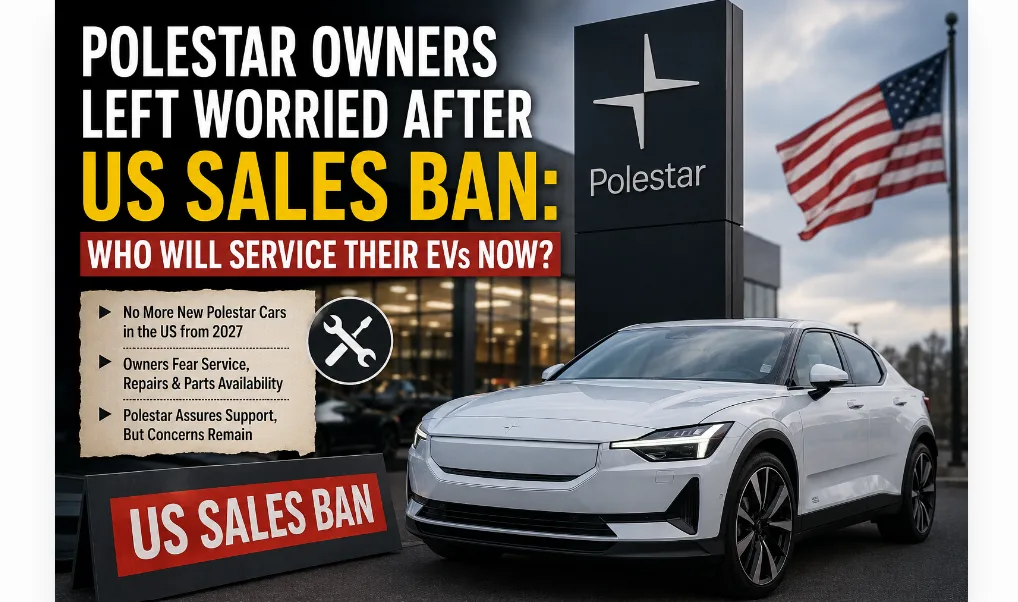
Polestar Owners Left Worried After US Sales Ban: Who Will Service Their EVs Now?
The American electric vehicle landscape just experienced a seismic shift that has left thousands of drivers holding the keys to vehicles with an uncertain future.
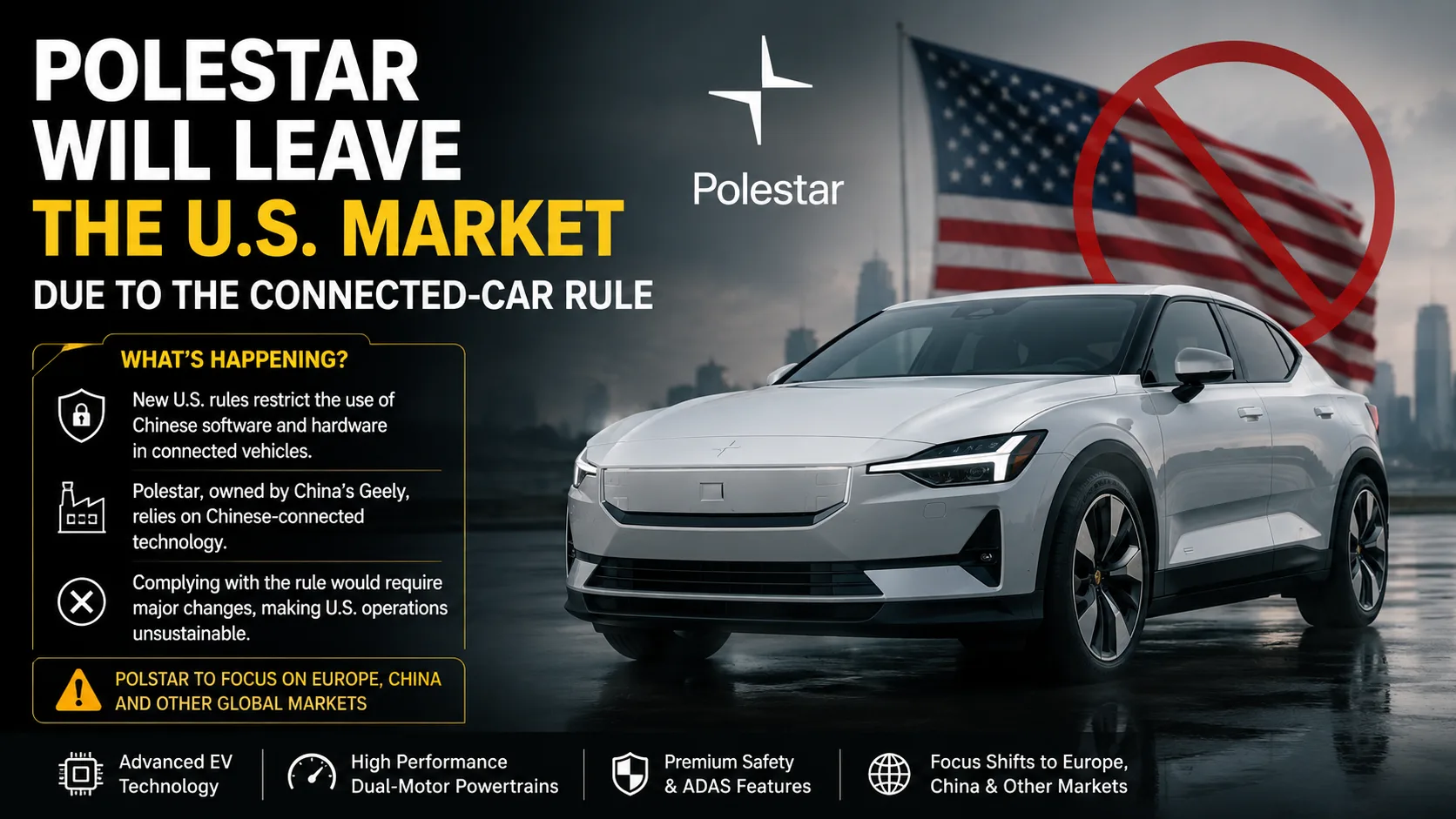
In a stunning regulatory development, the U.S. Department of Commerce officially denied Polestar an exemption under its stringent Connected Vehicle Rule. As a result, the Swedish-born, Chinese-owned electric car brand will be forced to halt sales of all new vehicles in the United States starting with the 2027 model year.
While the news sent shockwaves through global auto news networks and the wider automotive industry, the immediate fallout is being felt most acutely by everyday consumers.
Polestar owners left worried after US sales ban are flooding online forums and local spaces with urgent questions: Who will service our cars? Will our warranties be honored? Is the local dealership network about to vanish?
Why Has Polestar Been Barred From Selling Cars in the US?
The sudden halt of the brand’s American expansion stems directly from geopolitical tensions and strict trade policies. Finalized by the Bureau of Industry and Security (BIS), the Connected Vehicle Rule prohibits the sale or import of connected vehicles that integrate software or hardware with a “sufficient nexus” to countries deemed national security risks, specifically China and Russia.
Because Polestar is a subsidiary under the umbrella of Geely Polestar—the massive Chinese automotive conglomerate Geely Holding Group—the U.S. government ruled that the brand presents data security risks regarding vehicle telematics, cameras, and automated driving software.
This restriction goes well beyond standard import tariffs. The sales ban targets model-year 2027 vehicles and onward. Intriguingly, the ruling applies to ownership structure rather than where the cars are physically assembled.
Even though the Polestar 3 is actively manufactured in Charleston, South Carolina, and the Polestar 4 is assembled in Busan, South Korea, both models have been barred from future U.S. distribution because of their upstream Chinese software ties and corporate affiliation.
Why Existing Owners Are Concerned?
For current Polestar EV owners, the decision feels like a sudden abandonment. The primary source of anxiety centers on the long-term EV service support infrastructure. Electric cars are essentially complex, mobile computers. Unlike traditional combustion engine vehicles that can be repaired at any local mechanics’ garage, an electric vehicle relies heavily on specialized diagnostic equipment, proprietary software updates, and bespoke parts.
Owners are highlighting several critical concerns:
Software and Connectivity: Will the cellular modules, over-the-air (OTA) updates, and Google-integrated infotainment systems continue to receive optimization, or will they glitch without localized technical support?
Spare Parts Availability: If regional parts distribution networks close down, standard collision repairs could face months of delays.
Resale Values: The announcement of a brand exiting a market typically triggers a severe drop in secondary market values, harming owners’ long-term ownership experience.
Dealership Closures: Retail locations, known as Polestar Spaces, may face structural closures if they have no new inventory to sell.
What Has Polestar Said?
In an effort to maintain buyer confidence and mitigate panic, Polestar’s global leadership has issued a series of official clarifications. The company announced it will not formally appeal the Department of Commerce’s decision and will instead pivot its commercial strategy heavily toward Europe and expanding secondary markets like Canada and Southeast Asia.
For American drivers, Polestar insists that existing operations will protect current owners’ interests. The manufacturer officially confirmed that:
All active vehicle warranties remain 100% valid.
The supply chain for spare parts will continue uninterrupted to fulfill service requirements.
Software support and critical safety patches will continue to deploy for all current vehicles.
Existing inventory for model-year 2026 variants of the Polestar 3 and Polestar 4 can still be purchased until stock runs out.
Will Volvo Dealers Continue Supporting Polestar Cars?
To understand how servicing might work long-term, it helps to examine the foundational relationship of Volvo and Polestar. Polestar originated as Volvo’s high-performance racing wing before evolving into a standalone electric vehicle brand under Geely. Historically, the two brands have shared platforms, engineering assets, and retail networks.
Crucially, while Polestar’s authorization application was denied, Volvo successfully secured an exemption from the U.S. Department of Commerce to continue selling its 2027 connected vehicle lineup. Federal officials cited Volvo’s distinct governance structure and localized American data security framework as reasons for the approval.
Because Polestar relies heavily on Volvo’s established physical retail network for technical support, selected Volvo dealers are expected to remain the backbone for Polestar service and warranty repairs.
However, automotive industry analysts warn that individual franchise agreements could complicate things, meaning some Volvo dealerships might reduce their dedicated Polestar service bays over time as technicians shift focus toward Volvo’s own growing EV portfolio.
Could This Affect Polestar’s Future Globally?
While losing the U.S. market is a severe blow to brand reputation and investor confidence, it is not a fatal strike for Geely Polestar. The company’s financial data reveals that the U.S. accounted for a mere 6% of its global retail sales in the first quarter of 2026. Conversely, a staggering 80% of its volume is generated within the European market.
CEO Michael Lohscheller stated that the brand is entering a new era defined by regional market dynamics. Moving forward, Polestar will double down on European localized manufacturing, including plans to build the upcoming Polestar 7 on European soil.
Also Read: Feds Close Power Steering Investigation Into 376,000 Tesla Model 3 and Model Y EVs
What It Means for Current and Prospective Buyers
If you currently own a Polestar, there is no immediate reason to panic-sell your vehicle. The legal obligation to fulfill product warranties and supply parts ensures your car will remain roadworthy for years.
However, prospective buyers tracking the brand via an EV Buying Guide should exercise high caution; purchasing a vehicle from a brand winding down its regional sales operations requires accepting a heightened risk regarding long-term service convenience and accelerated depreciation.