US Auto Sales Remain Resilient in Q2 2026 Despite Inflation, Fuel Prices and Economic Uncertainty
The U.S. automobile market has historically taken a sharp hit during times of energy shocks and geopolitical crises. Yet, the second quarter of 2026 has thrown a major curveball at analysts.
Despite a punishing economic backdrop marked by stubborn inflation, high fuel prices stemming from the Middle East conflict, and mounting consumer spending concerns, the new vehicle sector showcased remarkable grit.
Wall Street predicted a significant drop-off in retail demand, expecting buyers to hit the brakes. Instead, massive hybrid vehicle sales volumes and affluent household buyers stepped up to pull the market through.
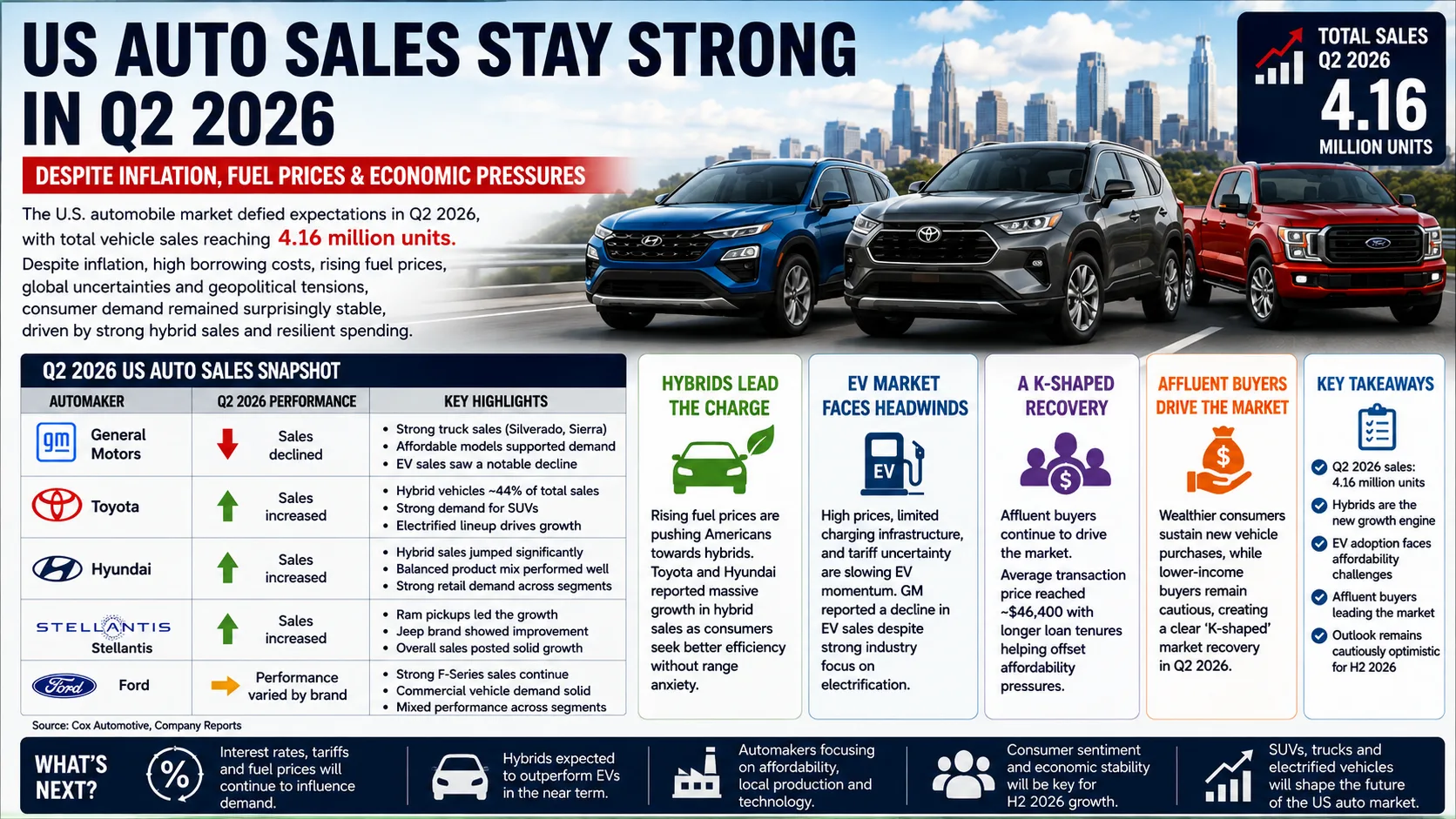
US Auto Sales Snapshot: Q2 2026 Performance
According to the latest retail data compiled by Cox Automotive and JD Power, total quarterly volumes held flat year-over-year at approximately 4.16 million vehicles sold.
The performance varied drastically across the corporate leaderboard, highlighting a deep divide between brands backed by strong hybrid options and those heavily exposed to slowing all-electric volumes.
| Automaker | Q2 2026 Performance | Key Highlights |
| General Motors | 714,896 units (-4.2%) | Retained #1 U.S. sales spot; heavy drop in EV sales; strong affordable ICE crossover demand. |
| Toyota Motor North America | 673,971 units (+1.1%) | Electrified vehicle portfolio jumped nearly 20%, bringing Toyota dangerously close to GM’s crown. |
| Hyundai Motor Group (incl. Kia) | 468,892 units (+3.4%) | Hybrid sales rocketed by 71%; fast-tracking local hybrid assembly line upgrades. |
| Stellantis | 328,284 units (+6.0%) | Massive recovery driven by aggressive Ram commercial truck incentives; Jeep volumes lagged. |
US Auto Market Defies Multiple Challenges
The economic backdrop for the US auto industry in early 2026 has been far from ideal. Retail auto loans hovered near historical highs, averaging 6.66% in June despite a minor third-of-a-point easing.
Furthermore, regional conflict disrupted crude shipping lanes, driving pump prices well past $4.00 per gallon for a large chunk of the spring season before pulling back to a $3.85 national average in late June.
Under normal economic modeling, this combination of high borrowing costs and steep operating expenses crushes consumer affordability. However, the market logged 4.16 million vehicles in total sales for the quarter.
Key Takeaway Box
The New Vehicle Resiliency Formula: The steady performance of the US automobile market in Q2 2026 rests on two main pillars: a massive shift toward fuel-efficient hybrid powertrains and an insulation layer provided by upper-income buyers who remain unaffected by microeconomic shocks.
Detailed Automaker Performance Breakdown
General Motors
While General Motors sales dipped 4.2% to 714,896 units, the Detroit giant successfully defended its domestic sales crown.
A major driver behind this resilience was inventory discipline and robust demand for full-size trucks like the GMC Sierra, alongside a highly successful pivot to ultra-affordable, sub-$30,000 internal combustion engine (ICE) entry crossovers like the Buick Envista and Chevrolet Traverse.
On the flip side, luxury division Cadillac fell 19% due to tough year-over-year comparisons following the expiration of initial EV purchase incentives.
Toyota
Toyota US sales posted a 1.1% gain to finish at 673,971 deliveries, closing the gap with GM. The story here is pure powertrain dominance: Toyota’s electrified line which is predominantly made up of traditional and plug-in hybrids surged 19.5% during the quarter. Electrified variants now make up a staggering 57% of total sales volume for the Japanese manufacturer.
Hyundai
Hyundai US sales (combined with sibling brand Kia) jumped 3.4% to 468,892 vehicles. The stand-out figure from their ledger was a phenomenal 71% spike in hybrid sales.
Demand is so overwhelming that Hyundai North American President Randy Parker confirmed the firm is moving at “warp speed” to retool its mega-factory in Georgia to produce more hybrid models directly on American soil.
Stellantis
Stellantis sales managed a surprise 6% rebound to 328,284 units. This recovery was entirely propped up by the Ram truck brand, which weaponized aggressive fleet and retail discounts to push light-duty pickups out of showroom doors. This commercial surge successfully offset softer retail interest in the premium Jeep lineup.
Hybrids Are Becoming America’s New Favorite
The electric vehicle market is facing a transitional slowdown, and hybrids have stepped into the spotlight as the ultimate middle ground. Cox Automotive tracking data reveals that 56% of active new car shoppers state that high gas prices directly motivate them to look at hybrid setups over pure combustion.
Instead of taking a gamble on sparse public charging infrastructure, buyers are leveraging traditional gas-electric setups to completely bypass pump anxiety.
Omdia Automotive data shows hybrid sales jumped 19% in the first half of the year alone, validating Toyota’s long-standing multi-pathway product strategy.
EV Market Faces Fresh Challenges
While hybrid setups thrived, the broader electric vehicle market ran into a wall during Q2. This trend is best illustrated by General Motors, which recorded a 33% year-over-year drop in pure battery EV deliveries this quarter.
[Pure EV Sales Headwinds in Q2 2026]
 ├── Consumer Affordability (High upfront MSRPs)
 ├── Infrastructure Deficits (Inconsistent public fast-charging networks)
 ├── Policy Shifts (Incentive expirations and moving tariff goalposts)
 └── Residual Values (Sharp depreciation in the used EV market)
This deceleration is forcing western legacy brands to recalibrate their manufacturing lines. Many are pulling back on aggressive pure-electric targets to conserve capital, focusing instead on bridging the gap with extended-range and standard hybrid options.
Affluent Buyers Continue to Drive the Market
The absolute core of the US car sales 2026 resiliency narrative lies in an ongoing K-shaped economic recovery. Lower-income brackets are being actively squeezed out of the new vehicle market due to compounding debt and living expenses. S&P Global Mobility data highlights this structural shift:
Under-$100k Income Households: Accounted for just 36% of new car sales recently, a steep plunge from the 51% market share they held back in 2020.
The Upper Bracket: Higher-earning buyers are keeping dealership floors busy, pushing the new car sales USA average transaction price up 1% year-over-year to $46,400 in June.
At the ultra-premium end, GM reported its retail transaction average reached a healthy $52,400, proving that luxury and truck buyers are mostly insulated from day-to-day inflationary pressures.
Also Read: Toyota Kirloskar Motor June 2026 Sales: Total Dispatches Climb 7% to 31,016 Units
Expert Analysis: The Hybrid Hegemony & Policy Wars
The structural patterns from this quarter suggest that the shift toward hybrids isn’t a temporary trend—it is a multi-year market defense mechanism.
Automakers like Toyota and Hyundai, who modularized their platforms to handle mixed powertrains seamlessly, are holding all the cards heading into the second half of the year.
They can scale hybrid output upward instantly to capture active demand, whereas brands that bet entirely on an overnight EV transition are carrying heavy inventory expenses.
Looking ahead, incoming technology tariffs and political shifts regarding trade blocks will likely keep pricing fluid. However, because factory inventory levels are normalizing—sitting at roughly 511,000 units for GM—car buyers can expect dealership incentives to steadily rise through Q3 and Q4 as brands fight to clear out remaining lots.
What It Means for the Global Auto Industry
The consumer shifting patterns seen in the US vehicle sales data offer critical lessons for global manufacturing hubs, including emerging markets like India and mature spaces across Europe.
Flexible Production Lines: The primary takeaway is that forcing an absolute electric transition ahead of consumer readiness creates inventory bottlenecks.
The Indian Parallel: In India, where mainstream EV charging infrastructure is still developing, the explosive success of US hybrids highlights why a multi-technology approach—combining strong hybrids, compressed natural gas (CNG), and pure EVs—is vital to maintaining structural volume.
Supply Chain Capital Allocation: Global suppliers must continue dividing their capital expenditures evenly between battery cell mining and high-efficiency ICE component optimization to avoid being caught off guard by regional regulatory changes.
Conclusion
The Q2 2026 U.S. auto sales results prove that despite inflation and geopolitical friction, the automotive sector remains remarkably adaptive.
While legacy giants like General Motors felt the sting of a cooling EV market, they managed to maintain their sales lead via high-margin trucks and affordable entry-level models.
Meanwhile, Toyota and Hyundai utilized massive hybrid growth to reshape the domestic leaderboard.
Also Read: Hyundai Motor India June 2026 Sales Report: Total Sales at 51,335 Units