
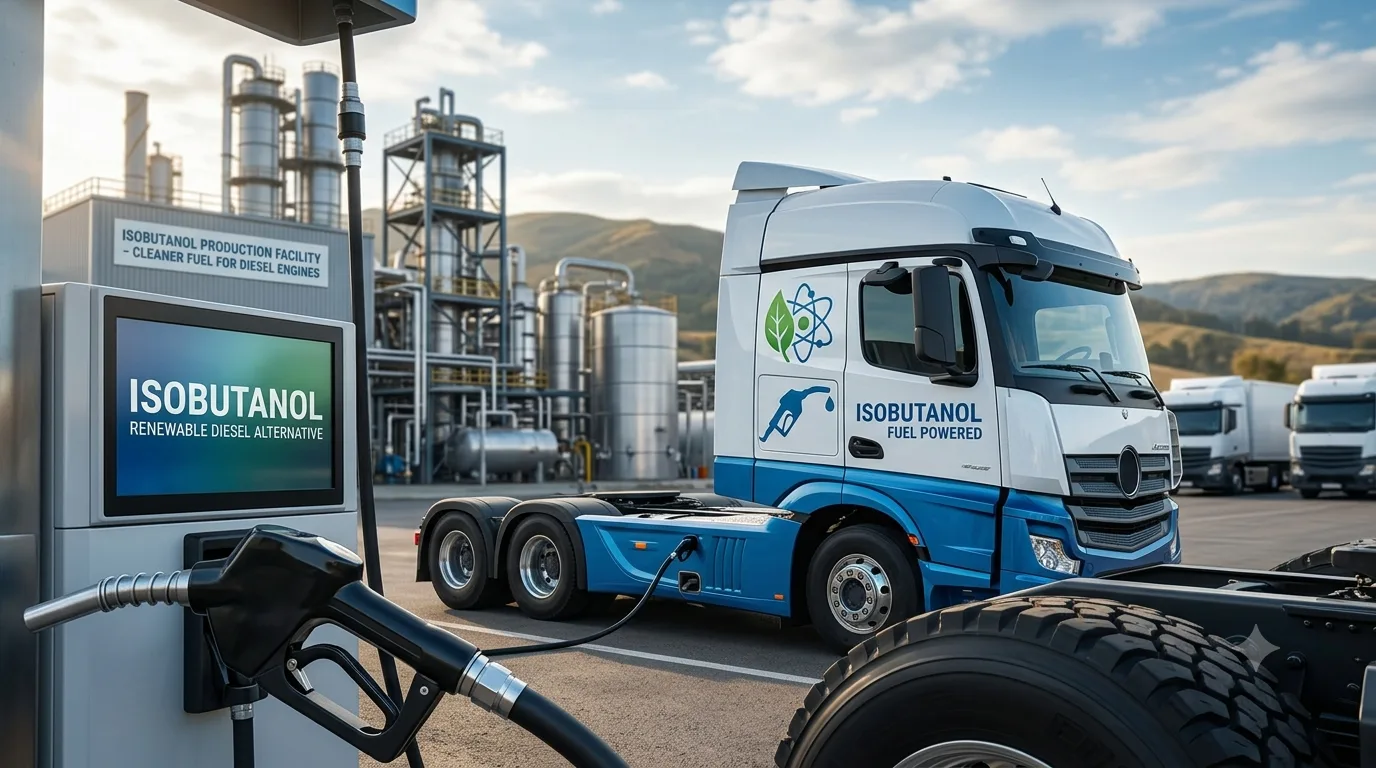
What Is Isobutanol and How Could Reshape the Future of Diesel?
The global automotive landscape is racing toward a zero-emission future. While battery-electric vehicles (EVs) are rapidly conquering the passenger car market, heavy-duty commercial transportation presents a much tougher challenge. Long-haul trucks, massive cargo ships, construction machinery, and agricultural tractors require immense power and long operational hours that current battery technology struggles to support.
To bridge this gap, the automotive industry and governments worldwide are searching for clean, liquid alternatives that can drastically reduce carbon footprints without requiring the immediate scrapping of millions of existing internal combustion engines. Enter isobutanol. This next-generation biofuel is rapidly gaining traction among scientists and energy experts as a potential game-changer that could permanently clean up and reshape the future of diesel power.
What Is Isobutanol?
Isobutanol is a four-carbon alcohol ($C_4H_9OH$) that can be produced through the fermentation of organic matter. Unlike traditional ethanol, which is a simple two-carbon alcohol ($C_2H_5OH$), isobutanol possesses a heavier, more complex molecular structure. This fundamental chemical difference gives it physical properties that closely mimic petroleum-based fuels.
      H   H   H
      |   |   |
H — C — C — C — OH
      |   |   |
      H   CH3 H

[Chemical Structure of Isobutanol (C4H9OH)]
While first-generation ethanol is typically made from food crops like corn and sugarcane, isobutanol is classified as an advanced, second-generation biofuel. It can be processed from non-food biomass, agricultural waste, corn stover, and sugarcane bagasse. Thanks to its longer carbon chain, isobutanol holds roughly 30% more energy density than ethanol. This high energy content makes it an incredibly efficient drop-in fuel candidate that doesn’t sacrifice performance.
How Isobutanol Works in Diesel Engines
Traditional ethanol cannot be blended directly into diesel fuel because it causes severe phase separation, where the fuel and water split into distinct layers. Isobutanol completely eliminates this issue due to its low affinity for water. It blends smoothly with conventional diesel, allowing oil companies to create stable, high-performance fuel blends without restructuring their formulas.
When introduced into a diesel engine, isobutanol improves combustion efficiency. Because the alcohol molecule contains inherent oxygen, it ensures a much cleaner burning process inside the cylinders. This oxygen-rich combustion drastically reduces the formation of harmful particulate matter, commonly known as soot or black smoke.
Modern diesel engines can run on low-to-moderate blends of isobutanol with minimal to no mechanical modifications. While ongoing global research is validating fuel system long-term durability, early testing confirms that its high combustion efficiency keeps the engine running smoothly under heavy loads.
Why Isobutanol Could Reshape Diesel
The commercial transportation sector is notoriously difficult to electrify because fleet operators cannot afford hours of downtime for battery charging. Isobutanol offers a realistic pathway to immediate decarbonization. By utilizing existing fuel pipelines, storage tanks, and pump networks, it bypasses the billions of dollars required to build entirely new hydrogen or electric charging grids.
+-------------------------------------------------------------+
|               KEY ADVANTAGES OF ISOBUTANOL                  |
+------------------------------+------------------------------+
| High Energy Density          | ~30% higher than ethanol,    |
|                              | closer to standard gasoline  |
+------------------------------+------------------------------+
| Low Water Absorption         | Prevents fuel line corrosion |
|                              | and phase separation         |
+------------------------------+------------------------------+
| Existing Infrastructure      | Can use current pipelines,   |
|                              | tankers, and pumps           |
+------------------------------+------------------------------+
| Improved Cold Operations     | Does not gel or freeze in    |
|                              | sub-zero temperatures        |
+------------------------------+------------------------------+
Furthermore, heavy industries operating in extreme conditions—such as mining, deep-sea marine shipping, and high-altitude farming—require fuels that remain stable across diverse climates. Isobutanol features a low vapor pressure and excellent cold-weather performance, meaning it will not vaporize prematurely in hot climates or gel up in freezing temperatures. These industrial advantages make it a highly attractive low-carbon fuel for heavy-duty applications.
Advantages of Isobutanol Over Traditional Diesel
Switching from conventional fossil diesel to an isobutanol blend yields massive environmental and mechanical benefits. The most significant advantage is the immediate reduction in lifecycle greenhouse gas emissions. Because the raw feedstocks absorb carbon dioxide while growing, the net carbon output is significantly lower than pulling fossil oil out of the ground.
Mechanically, isobutanol is far less corrosive than ethanol, which translates to substantially less engine wear on seals, gaskets, and fuel injectors.
Its superior storage stability means fleet operators can store the fuel in backup generators or seasonal agricultural equipment for months without worrying about fuel degradation or water accumulation.
Challenges and Limitations
Despite its undeniable benefits, isobutanol is not a silver bullet just yet. The primary hurdle blocking widespread adoption is the sheer cost of production. Engineering specialized yeast and bacteria strains to ferment complex biomass into isobutanol is a highly sensitive and expensive chemical process.
| Challenge Category | Key Structural Roadblock |
| Toxicity to Microorganisms | Yeast can tolerate up to 20% ethanol concentration during fermentation, but isobutanol becomes toxic to producing organisms at just 1% to 2%, requiring expensive continuous extraction systems. |
| Commercial Scale | There is currently a very limited number of high-output commercial bioprofineries operational globally. |
| Regulatory Hurdles | Securing formal fuel certifications and updating regional emissions standards remains a slow, bureaucratic process. |
| Alternative Competition | It faces stiff competition from direct EV mandates, hydrogen fuel cells, and traditional renewable diesel ($HVO$). |
Global Research and Industry Developments
Recognizing its potential, major automotive manufacturers, academic institutions, and energy corporations across North America, Europe, and Asia are pouring millions into advanced biotechnology.
Scientists are using metabolic engineering to develop robust yeast strains that can tolerate higher concentrations of isobutanol during production, which could drastically lower manufacturing overhead.
In the commercial sector, major oil companies are partnering with tech startups to retrofit existing, older ethanol plants into highly efficient isobutanol production facilities. These pilot programs are aimed at creating scalable supply chains that can reliably serve transit buses and commercial shipping fleets over the coming decade.
Could Isobutanol Reach India?
India is currently at the forefront of the global bioenergy movement, having successfully advanced its 20% ethanol-blended petrol (E20) targets ahead of schedule.
However, because diesel consumption in India is roughly double that of petrol, the Indian government is actively looking for a heavy-duty alternative to cut down expensive crude oil imports.
In a massive policy shift, the Ministry of Road Transport and Highways recently announced that India is planning to introduce a formal mandate permitting up to a 15% isobutanol blend in diesel.
State-run giants like Bharat Petroleum Corporation Limited (BPCL) are already conducting strategic research, and the Automotive Research Association of India (ARAI) is actively testing existing commercial engines.
While setting up local manufacturing loops for this advanced alcohol will take time, isobutanol could perfectly complement India’s aggressive green energy strategy.
The Times of Gen-Z Opinion
Isobutanol is rapidly emerging from the confines of laboratory research to stake its claim as a pillar of future transport. By combining the high energy density of petroleum with the low-carbon footprint of advanced organic waste, it solves the unique physical challenges that traditionally kept alcohols out of heavy-duty diesel engines.
As refining technologies mature and blending mandates fast-track commercial distribution, this next-generation biofuel stands ready to fundamentally clean up the future of commercial trucking and heavy industry.