Why the Bajaj Pulsar Series Continues to Dominate India’s Motorcycle Market?
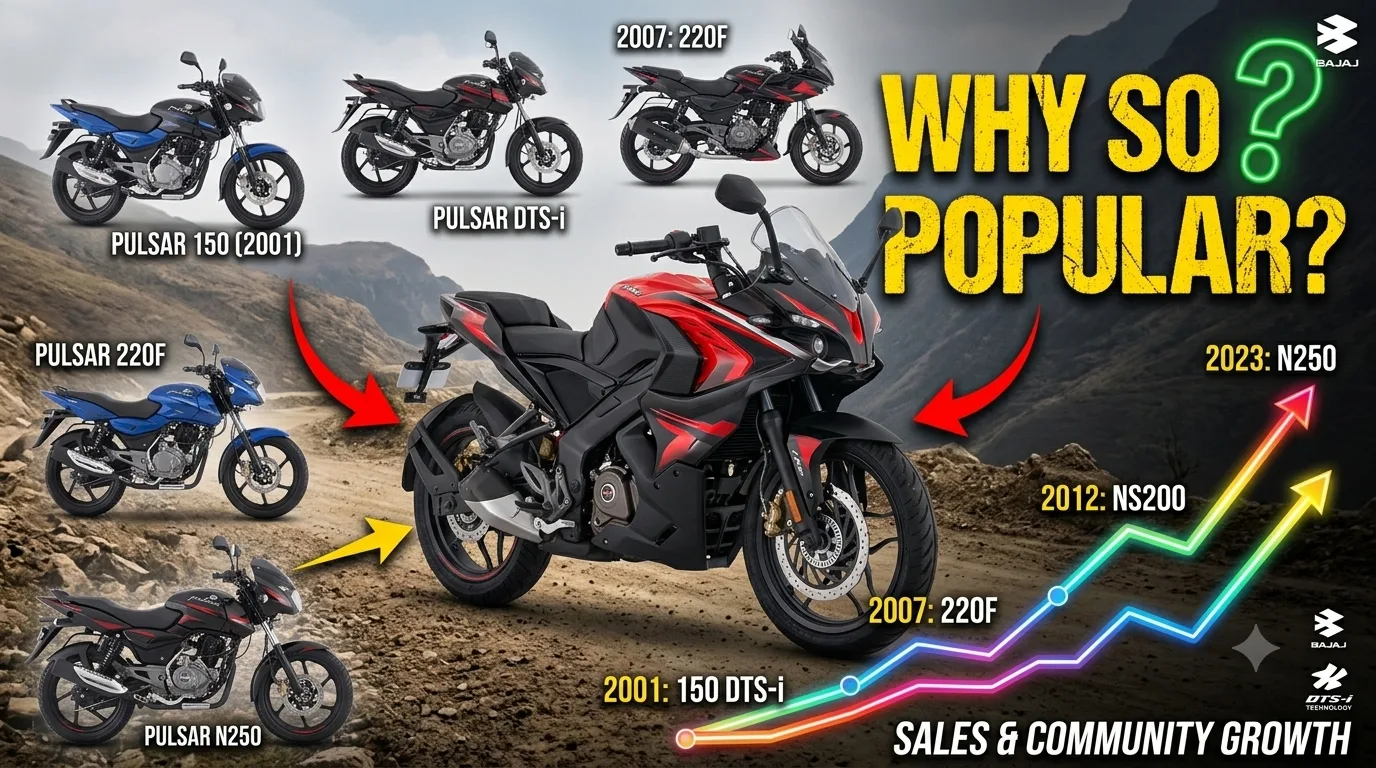
When Bajaj Auto introduced the Bajaj Pulsar 150 and 180 twins back on November 24, 2001, it fundamentally transformed the Indian two-wheeler landscape.
Prior to its arrival, the domestic market focused almost exclusively on fuel-efficient 100cc commuter bikes. The Pulsar injected raw performance, aggressive muscular styling, and aspirational value into the mainstream riding culture.
Over two decades and millions of sales later, the Pulsar lineup remains the benchmark for performance commuting in India and over 50 global export markets.
First-Mover Advantage and the Iconic “Definitely Male” Image
Bajaj strategically targeted young riders seeking thrills beyond ordinary commuter motorcycles. Co-developed with Tokyo R&D and styled by motorcycle designer Glynn Kerr, the original Pulsars debuted with muscular fuel tanks, a long wheelbase, standard front disc brakes, and an authoritative exhaust note.
Backed by the memorable “Definitely Male” marketing campaign, the brand forged an emotional bond with youth culture. By creating a distinct identity built around power and street presence, Bajaj established early dominance in the 150cc+ sports segment that competitors struggled to challenge for years.
Pioneer of First-in-Segment Engineering Technologies
A primary driver of the Pulsar’s enduring popularity is Bajaj’s commitment to democratizing high-end engineering. Rather than keeping tech exclusive to expensive imported motorcycles, Bajaj consistently introduced advanced hardware to mass-market price points:
Digital Twin Spark Ignition (DTS-i): Introduced in 2003, DTS-i technology utilized two spark plugs for faster, more complete combustion, raising both power output and fuel efficiency.
Gas-Charged Nitrox Shock Absorbers & LED Taillights: Rolled out in the mid-2000s to elevate ride quality and visual appeal.
Fuel Injection & Oil Cooling: The iconic Pulsar 220F introduced oil cooling, fuel injection, and clip-on handlebars to affordable performance motorcycles.
Perimeter Frames & Liquid Cooling: The launch of the Pulsar NS200 brought pressed-steel perimeter frames and four-valve liquid-cooled engines derived from KTM technology to urban streetfighters.
A Wide Portfolio Catering to Every Budget and Riding Style
Bajaj continuously expands the Pulsar umbrella to cover every price point and displacement class:
Entry-Level Performance (125cc – 150cc): Models like the Pulsar 125, Pulsar 150, and N150 deliver iconic Pulsar styling alongside high fuel efficiency for daily commuters.
Core Sport Commuters (160cc – 200cc): The NS160, N160, NS200, and RS200 target college students and young professionals wanting aggressive streetfighter or full-faired styling.
Flagship Performance (250cc – 400cc): Models including the N250, F250, and the flagship NS400Z offer powerful highway touring dynamics at accessible prices.
This broad product strategy ensures that as a customer’s riding needs and budget grow, they can step up to a more powerful Pulsar without leaving the brand.
Unbeatable Value for Money and Low Cost of Ownership
The core philosophy behind every Pulsar model is high power per rupee. Bajaj optimizes localized manufacturing and platform sharing across its lineup, allowing the company to price Pulsar bikes competitively against international rivals.
Furthermore, an extensive nationwide service network makes replacement parts easily accessible and affordable. Low routine maintenance costs ensure that young owners can maintain their vehicles without excessive financial strain, preserving strong resale value in the pre-owned market.
Conclusion
The Bajaj Pulsar series achieved cult status in India by constantly evolving to match rider expectations. By combining aggressive design, continuous engineering upgrades, a versatile variant lineup, and low ownership costs, Bajaj maintains the Pulsar’s reign as India’s definitive sports commuter.
Also Read: Maruti Grand Vitara Crosses 4 Lakh Sales Mark in India